At first glance, art and fashion can feel like two completely different worlds. Art is often seen as something emotional, expressive, and deeply personal. Fashion, on the other hand, is often treated like commerce first, creativity second. One lives in galleries, museums, studios, and private collections. The other lives on runways, in stores, on bodies, in campaigns, and in the constant pressure of trends and seasons.
But once you look closer, the line between them starts to blur. Art has a business model. Fashion has a creative core. Both depend on taste, branding, exclusivity, storytelling, and the ability to make people care. And in many ways, the real conversation is not about whether art and fashion are different. It is about how they work inside the same system of value, attention, desire, and status.
That is where things get interesting.
Art and fashion are both built around meaning
Neither art nor fashion exists in a vacuum. A painting is not just paint on canvas, and a dress is not just fabric stitched together. Both are objects that carry meaning. Both can signal identity, class, culture, rebellion, beauty, and belonging. Both can be read emotionally and economically at the same time.
A painting can be purchased as an investment, displayed as a symbol of taste, or cherished because it moves someone personally. A designer bag can be bought for function, but also for status, aspiration, or as a way of participating in a certain world. In both cases, the object is never just the object. Its value is shaped by the story around it.
That story is a business tool.
In art, the story may be about the artist’s genius, rarity, or cultural significance. In fashion, the story may be about heritage, craftsmanship, celebrity, or the fantasy of a brand. In both industries, narrative creates desire. And desire creates value.
Scarcity is part of the game
One of the biggest overlaps between art and fashion is scarcity. Scarcity makes things feel special. It makes people want them more. It also gives brands and artists more power over pricing.
In art, scarcity is built in. There is often only one original piece, or a very limited edition. That uniqueness is central to the work’s value. In fashion, scarcity is more manufactured, but just as effective. Limited drops, exclusive collections, runway-only pieces, archival reissues, and one-of-a-kind couture all create the same effect. The more unavailable something feels, the more people want it.
This is not just about ego or hype. It is about economics. Scarcity turns creativity into a premium product. It allows brands and artists to position themselves above the ordinary market. It also creates a sense of urgency, which is one of the strongest forces in consumer behavior.
People do not always buy the thing. Sometimes they buy the feeling of having gotten it before everyone else.
Branding changes everything
The business of art and the business of fashion both rely heavily on branding, even if they do not always call it that.
In art, the artist’s name matters enormously. Sometimes the signature is part of the value. The same object can be worth very different amounts depending on who made it and how that person is perceived. In fashion, the label carries the weight. A simple white T-shirt can feel completely different depending on whose logo is attached to it.
Branding turns creative work into a recognizable language. It tells people what to expect, what to admire, and what kind of social identity comes with ownership. A strong brand does not just sell products or pieces. It sells a point of view.
That is why both industries care so much about consistency, even when they are trying to appear innovative. Art collectors want to know where an artist fits within a larger cultural conversation. Fashion consumers want to know whether a brand still feels relevant. In both spaces, identity is currency.
The runway and the gallery both perform
There is also a theatrical side to both industries. Art exhibitions and fashion shows are not just about the work itself. They are about staging, atmosphere, anticipation, and interpretation.
A gallery opening is rarely only about looking at art. It is about context, audience, and the social ritual around the work. A fashion show is not only about clothes. It is about presentation, mood, and the message behind the collection. In both cases, the event becomes part of the product.
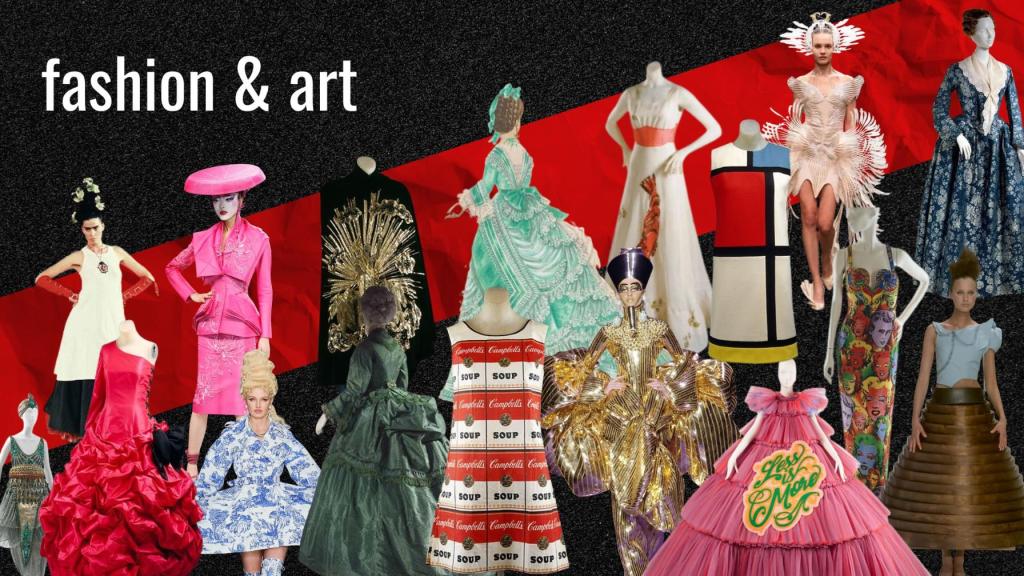
This is why so many fashion brands borrow from the art world, and why so many artists influence fashion. The visual language is shared. The idea of creating a world around an object matters in both industries. You are not just selling a dress or a painting. You are selling entry into a carefully built universe.
That universe often includes exclusivity, cultural knowledge, and the sense that not everyone will understand it. And honestly, that is part of the appeal.
Money affects how creativity is read
There is a strange tension in both art and fashion around money. People often want creativity to feel pure, but both industries are deeply shaped by commercial realities.
In art, there is always debate about whether market value distorts artistic value. Does a piece become more important because it sells for millions? Or does the price simply reflect a system that rewards certain names, institutions, and collectors? In fashion, there is a similar tension. Does a designer become less creative because a brand is profitable? Or does commercial success simply mean the work reached people effectively?
The truth is messier than the myth of pure creativity.
Both industries operate under pressure. Artists need funding, representation, and buyers. Fashion designers need investors, production, distribution, and sales. Neither can survive on inspiration alone. The business side does not erase the creative side. It shapes it, limits it, and sometimes elevates it.
That is not necessarily a bad thing. Constraints can sharpen vision. But they can also flatten it when profit becomes the only measure that matters.
Luxury is the shared language
Luxury is where the collision between art and fashion becomes especially visible.
Both industries understand that luxury is not just about price. It is about time, process, rarity, craftsmanship, and emotional charge. A luxury object is supposed to feel intentional. It should make you slow down. It should make you notice detail. It should feel like someone cared enough to make it matter.
That is one reason fashion increasingly borrows the logic of art. It wants to be seen as collectible, not disposable. It wants to be discussed, archived, and remembered. Art, meanwhile, often moves closer to fashion by becoming more market-aware, more branded, and more connected to lifestyle and image.
In a culture where everything is visually consumed online, luxury is no longer just private. It is performative. It is photographed, posted, and interpreted by an audience that may never own the thing, but still wants to understand the world it represents.
This is why a fashion campaign can feel like an art installation, and why a contemporary artwork can feel like a brand experience.
Collaboration is no longer the exception
There was a time when art and fashion collaborations felt special because they seemed rare. Now they are part of the system.
Designers work with artists. Artists collaborate with luxury houses. Brands commission installations, sculptures, films, and exhibitions. Museums host fashion retrospectives. Fashion houses sponsor art fairs. Everyone wants to borrow the cultural credibility of the other side.
This can be exciting when the collaboration is thoughtful and genuinely expands the work. It can also feel shallow when art is treated like decoration or when fashion uses art only as a marketing shortcut. But either way, the partnership reveals something important. The industries need each other.
Fashion offers circulation, visibility, and immediacy. Art offers depth, prestige, and intellectual framing. Together, they create a stronger cultural product than either one can alone.
The audience has changed too
Part of why art and fashion now collide so often is because the audience has changed. We do not experience culture the way we used to. We scroll it, archive it, repost it, remix it, and discuss it in real time.
That changes the business entirely.
A fashion collection is no longer just seen on a runway. It is dissected online within minutes. An artwork is no longer just encountered in a museum. It lives on social media, in auction headlines, in memes, and in digital conversations. Visibility is everything. Attention is capital.
This makes the business of both art and fashion more accelerated, but also more fragile. Trends move fast. Relevance fades fast. Aesthetic language gets copied, flattened, and repackaged constantly. To survive, both industries have to keep reinventing how they hold attention.
That pressure can produce brilliance. It can also produce noise.
So where do they really collide?
They collide in value. They collide in storytelling. They collide in exclusivity, branding, luxury, performance, and cultural status. They collide in the tension between creativity and commerce, between what is made and what is marketed, between emotional meaning and financial worth.
But maybe the deeper collision is this: both art and fashion are trying to answer the same question.
What makes something worth wanting?
Sometimes the answer is beauty. Sometimes it is rarity. Sometimes it is skill. Sometimes it is identity. Sometimes it is the promise that owning it will change how the world sees you, or how you see yourself.
That is why these industries remain so powerful. They are not just selling objects. They are selling significance.
And significance is one of the most profitable things in the world.
Final thoughts
The business of art and the business of fashion may look different on the surface, but they are connected by the same invisible machinery. Both depend on taste. Both depend on narrative. Both depend on cultural desire. And both depend on people believing that what they are looking at is more than just material.
That is the real overlap. Not just in aesthetics, but in economics. Not just in expression, but in value creation.
Art asks us to look closer. Fashion asks us to wear the feeling. And in the space where those two impulses meet, a whole economy of meaning is built.
If you strip away the glamour, the branding, and the market language, what remains is something very human. The urge to make things that matter. The urge to own things that say something. The urge to turn beauty into value, and value back into beauty.
That is where art and fashion keep meeting. And that is why their business will always be intertwined.
We do not own the rights to any of these images and they have been used in good faith. Every effort has been made to ensure that all images are used with proper credits. If you are the rightful owner of any image used on our site and wish to have it removed, please contact us at ayerhsmagazine@gmail.com and we will promptly remove it. We are a non-commercial, passion-driven, independent fashion blog and do not intend to infringe any copyright. Thank you for your understanding.
 Ayerhs Magazine