
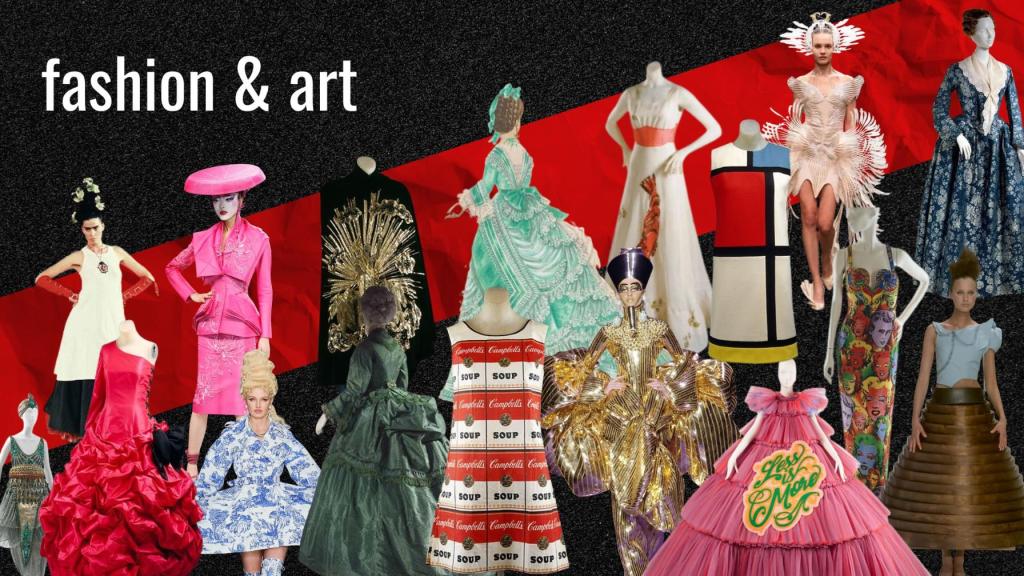
There is a quiet kind of memory that does not live in words. It lives in fabric, in brushstrokes, in silhouettes, in color palettes that feel familiar before they are explained. Fashion and art do something similar at their core. They hold onto identity in ways that feel both deeply personal and collectively understood. They become archives, not in the traditional sense of files and documents, but as living, evolving records of who we are, where we come from, and how we see ourselves.
When we talk about archives, we often imagine something static. Something preserved behind glass. But fashion and art refuse to stay still. They move with time, shift with culture, and adapt with each generation. And that is exactly why they are such powerful carriers of identity.
Fashion, at first glance, might feel fleeting. Trends come and go, aesthetics change, and what felt current last year can feel outdated today. But underneath that constant change, fashion quietly stores layers of cultural meaning. A sari is not just a garment. A kurta is not just everyday wear. Denim in one context is casual, in another it becomes political, symbolic, even rebellious. The meaning of clothing is never fixed. It is shaped by who wears it, where it is worn, and when.
The same goes for art. A painting, a sculpture, a photograph. They all hold fragments of the time they were created in. But more importantly, they hold the perspective of the person who made them. Art captures how someone saw the world, and in doing so, it preserves a version of culture that might otherwise fade.
What makes both fashion and art unique as archives is that they are not neutral. They are subjective. They are emotional. They are selective. They tell stories, but never the whole story. And that is where things get interesting.
Identity is not one thing. It is layered, contradictory, constantly shifting. Fashion reflects this perfectly. Think about how people dress differently depending on context. Work, home, social spaces, online presence. Each version is real, but each one highlights a different part of identity. Over time, these choices create a visual record. Not just of individual identity, but of collective shifts.
You can look at fashion from a specific decade and immediately sense what was happening culturally. The silhouettes, the colors, the textures. They all point to something bigger. Economic conditions, political climates, social movements. Even the idea of what is considered “acceptable” or “desirable” is embedded in clothing.
Art does this too, but in a slightly different way. While fashion is worn and lived in, art often steps back and reflects. It comments, questions, sometimes resists. It captures not just what is visible, but what is felt. And when you place art and fashion side by side, you start to see a fuller picture of culture. One that includes both lived experience and interpretation.
There is also something important about who gets to create these archives. Historically, both fashion and art have been shaped by power structures. Certain narratives are preserved, others are ignored. Certain aesthetics are celebrated, others are dismissed. This is not accidental. It reflects whose identities are considered valuable enough to be remembered.
But that is changing. Slowly, but noticeably.
More voices are entering both spaces. Designers are reworking traditional garments in ways that feel current but still rooted. Artists are reclaiming visual languages that were once overlooked or misrepresented. There is a growing awareness that identity is not singular, and culture is not fixed.
This shift is not just about inclusion. It is about accuracy. Because culture cannot be archived properly if large parts of it are missing.
Social media has complicated this even further. On one hand, it has accelerated trends to an almost overwhelming pace. On the other, it has created a massive, decentralized archive. People are documenting their own identities in real time. Outfit photos, moodboards, digital art, styling experiments. It is all being recorded, shared, reshaped.
This raises an interesting question. What happens when everyone becomes their own archivist?
The answer is not simple. It means that the archive becomes more diverse, but also more fragmented. There is no single narrative anymore. Instead, there are thousands of micro narratives, all existing at once. Fashion aesthetics like “clean girl,” “indie sleaze,” or “desi core” are not just trends. They are snapshots of how people are choosing to represent themselves at a specific moment.
Art is responding to this too. Digital art, mixed media, AI-assisted visuals. The definition of what counts as art is expanding, and with it, the ways identity can be recorded.
But there is also a tension here. The speed at which things are created and consumed can make everything feel temporary. If everything is constantly changing, what actually gets remembered?
This is where intention matters.
Not everything that exists becomes part of an archive. It is the pieces that resonate, that are repeated, that are referenced again and again, that start to solidify into cultural memory. A certain print, a silhouette, a visual style. Over time, they become markers of identity.
Fashion often does this through repetition and reinterpretation. A traditional motif might appear in a contemporary collection. A vintage silhouette might return with a modern twist. These moments are not just about nostalgia. They are about continuity. They show how identity evolves without completely losing its roots.
Art, on the other hand, often preserves through emphasis. It highlights specific moments, emotions, or perspectives and holds them in place. It forces attention. It asks the viewer to pause, to consider, to remember.
Together, fashion and art create a kind of layered archive. One that is not linear, but interconnected. You can trace influences across time, across mediums, across cultures. A painting might inspire a collection. A subculture’s style might influence visual art. The boundaries blur, and in that blur, identity becomes more complex and more real.
There is also something deeply personal about how we engage with these archives. The clothes we choose, the art we are drawn to. They say something about how we see ourselves, or how we want to be seen. In that sense, we are not just consuming culture. We are participating in it.
Every time someone chooses to wear something that reflects their background, or creates something that expresses their experience, they are adding to the archive. Even if it feels small or insignificant in the moment, it contributes to a larger picture.
And sometimes, the most powerful archives are the ones that exist outside of institutions. Not in museums or galleries, but in everyday life. Family photographs, inherited garments, handmade pieces, street style. These are often overlooked, but they hold some of the most honest representations of identity.
Because they are not curated for an audience. They are lived.
This brings up another layer. Authenticity.
There is a constant conversation around what is “real” versus what is “performed” in both fashion and art. Especially in an era where aesthetics can be adopted, borrowed, or even appropriated. When does representation become imitation? When does appreciation turn into erasure?
There are no easy answers, but it highlights how sensitive identity is when it becomes visual. Fashion and art do not just reflect culture. They shape how it is perceived. And that comes with responsibility.
To archive culture is not just to preserve it. It is to represent it with care.
At the same time, identity is not something that needs to stay untouched to be valid. It grows, mixes, evolves. Cultural exchange is natural. It has always existed. The key difference lies in awareness. In understanding the context behind what is being referenced or reinterpreted.
When done thoughtfully, fashion and art can create connections across cultures. They can introduce people to perspectives they might not have encountered otherwise. They can make identity feel expansive rather than restrictive.
And maybe that is the most important part.
Fashion and art do not just archive identity. They expand it.
They allow for multiple versions of self to exist. They make space for contradiction. They show that culture is not something you inherit once and carry unchanged. It is something you interact with, question, reshape.
Over time, this creates a richer archive. One that does not just look back, but also moves forward.
So when you look at a garment, or a painting, or even a digital collage, it is worth asking what it is holding onto. What part of identity is being preserved here? What part is being reimagined?
Because somewhere in that visual language, there is a story. Not always obvious, not always complete, but still there.
And collectively, these stories build an archive that is far more alive than any traditional record.
An archive that breathes, adapts, and continues to grow with every new expression of identity and culture.
We do not own the rights to any of these images and they have been used in good faith. Every effort has been made to ensure that all images are used with proper credits. If you are the rightful owner of any image used on our site and wish to have it removed, please contact us at ayerhsmagazine@gmail.com and we will promptly remove it. We are a non-commercial, passion-driven, independent fashion blog and do not intend to infringe any copyright. Thank you for your understanding.
 Ayerhs Magazine