
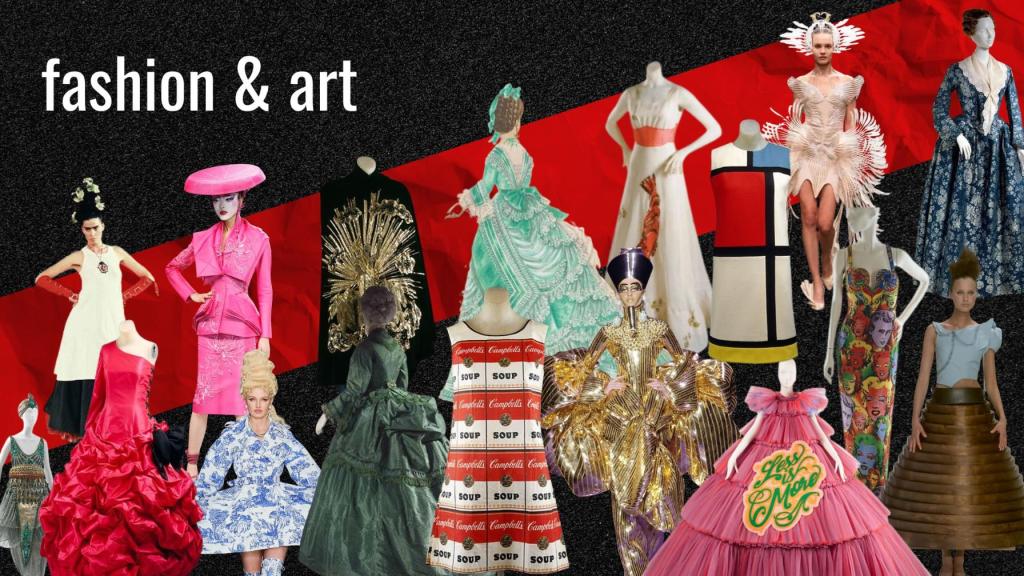
For something so visual, so everywhere, fashion has spent a long time not being taken seriously. Not ignored, never that, but often reduced to surface. Trends, shopping, aesthetics. Something fun, expressive, even powerful, but rarely placed in the same category as “real” art.
That divide is starting to feel a bit outdated.
Right now, it is less about asking whether fashion can be art, and more about realizing that it has been functioning as art all along. The difference is that people are finally beginning to acknowledge it.
The Divide That Never Fully Made Sense
For years, art and fashion were positioned as opposites. Art was framed as intellectual, timeless, and worthy of preservation. Fashion was seen as seasonal, commercial, and disposable.
Art belonged in museums. Fashion belonged in stores.
Even within fashion, there was resistance to being labeled as art. Some designers actively rejected the idea, wanting their work to be understood as clothing first. Something to be worn, not just observed.
But that distinction has always been a little shaky.
Architecture is functional, yet it is considered art. Design solves problems, yet it is exhibited and studied as art. Performance art depends on the body, on movement, on time. None of these are disqualified for being “useful.”
So why was fashion?
The answer has less to do with the work itself and more to do with how we were taught to see it.
Fashion Has Always Spoken the Language of Art
If you look closely, fashion and art have always been working with the same tools.
Composition, color, texture, proportion, symbolism. The way a silhouette is constructed is not that different from how a sculpture is shaped. The way a collection builds a mood is not that far from how a painting carries emotion.
Fashion tells stories. About identity, power, class, gender, desire. It reflects the moment it exists in, sometimes subtly, sometimes very directly.
It is also deeply referential. Designers constantly pull from art history, from movements, from visual culture. And in return, artists have always documented and responded to fashion.
The relationship has never been separate. It has always been intertwined.
What is changing now is not the connection, but the recognition of it.
Institutions Are Finally Catching Up
One of the biggest shifts has come from institutions. Museums and galleries are no longer treating fashion as a side category or a novelty.
Fashion exhibitions are now some of the most attended, most talked about cultural events. They are curated with the same seriousness as fine art shows, placing garments in conversation with paintings, sculpture, and installation.
This kind of validation matters. It changes how people approach fashion. Instead of just asking “would I wear this,” the question becomes “what is this saying?”
Even outside museums, the way fashion is presented has evolved. Editorials feel more like visual essays. Runways feel like performances. Campaigns feel cinematic, layered with references and meaning.
Fashion is no longer just being shown. It is being framed.
Fashion Has Become More Conceptual
At the same time, fashion itself has shifted.
There is a growing focus on concept over just wearability. Designers are pushing silhouettes to extremes, questioning ideas of beauty, exploring identity, politics, and the body in ways that feel closer to contemporary art than traditional clothing design.
Some garments are not even meant to be practical. They exist to provoke, to challenge, to communicate something bigger than function.
And even when clothes are wearable, they often carry a deeper narrative. A collection might explore nostalgia, critique consumerism, or play with ideas of gender in subtle ways.
This move toward concept is part of why fashion is being taken more seriously. It demands interpretation. It invites analysis.
It asks to be read, not just seen.
The Body Changes Everything
One thing that makes fashion different from other art forms is the body.
A painting exists on a wall. A sculpture exists in space. But fashion exists on someone. It moves, shifts, reacts. It is completed by the person wearing it.
That makes it more immediate, more personal.
It is not just something you observe. It is something you participate in.
And that participation is powerful. Because what we wear is never neutral. It shapes how we are perceived and how we perceive ourselves.
In that sense, fashion is not just art you look at. It is art you live in.
The Pushback Is Still There
Even now, not everyone is fully convinced.
Fashion is still tied to commerce in a very visible way. It is part of an industry that sells, produces, and moves quickly. That association makes it harder for some people to separate the artistic value from the business behind it.
There is also the argument that fashion is too temporary. Trends change. Collections come and go. What feels relevant today might not hold the same weight tomorrow.
But art is not as permanent as we once believed either. Contemporary art has embraced change, ephemerality, and even disappearance. Performance pieces end. Installations are dismantled. Digital works evolve or vanish.
So the idea that art must be timeless does not hold as strongly anymore.
And once that definition loosens, fashion fits into the conversation much more naturally.
A Generational Shift in Perspective
There is also a cultural shift happening, especially with younger audiences.
Gen Z does not seem particularly interested in strict categories. Art, fashion, music, internet culture, it all blends. A runway look can reference a painting, turn into a meme, and become a cultural moment within hours.
The hierarchy that once placed art above fashion feels less relevant in this context.
What matters more now is impact. Visual language. How something makes you feel, think, react.
And fashion does all of that, constantly.
Social media has also played a role in this shift. It has made fashion more accessible, but also more open to interpretation. People are engaging with fashion in a more analytical way, breaking down references, meanings, and intentions.
It is no longer just about liking a look. It is about understanding it.
So, Is Fashion Finally Being Taken Seriously?
Yes, but not in a clean, complete way.
Fashion is being taken more seriously than before. It is being studied, exhibited, and discussed with more depth. People are recognizing its ability to communicate, to challenge, to exist beyond function.
But it still sits in an in-between space.
Between art and commerce. Between expression and utility. Between permanence and change.
And maybe that is exactly where it belongs.
Fashion does not need to fully detach from its practical side to be considered art. In fact, that duality is what makes it interesting.
It is both something you can wear and something you can interpret. Something that exists in your daily life but also carries layers of meaning.
Final Thought
Fashion did not suddenly become art.
What changed is how we are looking at it.
The lens has shifted. The definitions have expanded. And in that shift, fashion is finally being given the space to be understood for what it has always been.
Not just clothing. Not just trend.
But a form of expression that reflects culture, identity, and time in a way that is just as complex, just as intentional, and just as worthy of attention as any painting or sculpture.
Once you start seeing it like that, it becomes impossible to reduce fashion to something shallow.
It becomes something much bigger.
We do not own the rights to any of these images and they have been used in good faith. Every effort has been made to ensure that all images are used with proper credits. If you are the rightful owner of any image used on our site and wish to have it removed, please contact us at ayerhsmagazine@gmail.com and we will promptly remove it. We are a non-commercial, passion-driven, independent fashion blog and do not intend to infringe any copyright. Thank you for your understanding.
 Ayerhs Magazine