
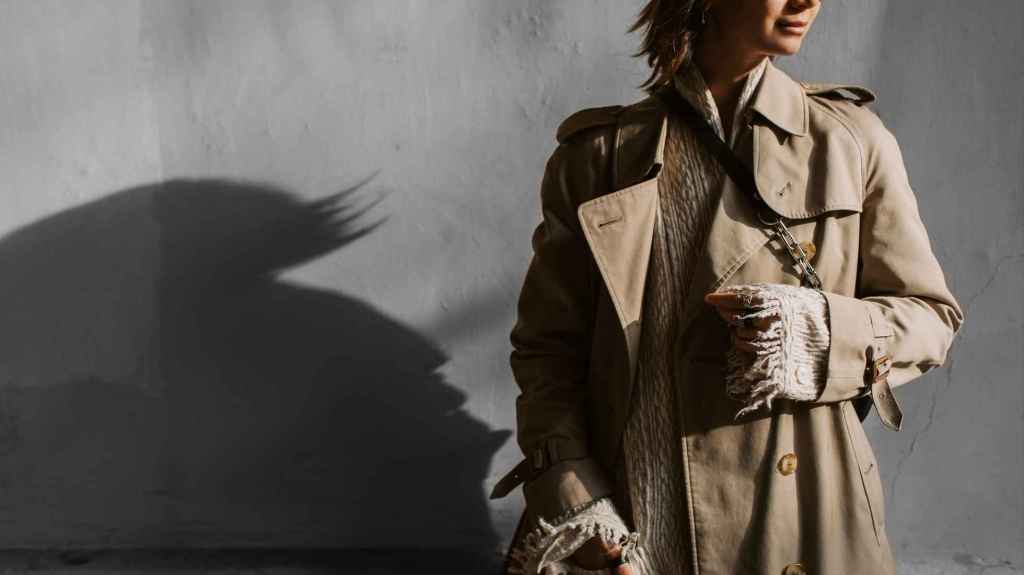
There are few garments in the modern wardrobe with a backstory as dramatic as the trench coat’s. It has survived mud-filled trenches, decades of shifting fashion, and countless reinventions, yet it still looks essentially the same today as it did a century ago: a belted, khaki-colored coat with a storm flap, deep pockets, and an unmistakable air of authority. To understand why the trench coat has never gone out of style, you have to go back to its origins — not on a runway, but on a battlefield.
Before the Trench: The Problem With Wool
Long before “trench coat” was a phrase anyone used, British and French armies relied on heavy wool greatcoats to keep soldiers warm and dry. These coats worked reasonably well in dry conditions, but they had a serious flaw: wool absorbs water. In the rain-soaked campaigns of the 19th century, soldiers were often weighed down by greatcoats that could double in weight when soaked, restricting movement and making life miserable in the field.
What the military needed was something lighter, more weatherproof, and better suited to the realities of modern warfare — a need that would soon collide with a revolution happening in the textile industry.
Two Englishmen and a New Kind of Fabric
The trench coat’s origin story runs largely through two British outfitters: Thomas Burberry and John Emary (founder of Aquascutum). Both men, working somewhat independently in the mid-to-late 19th century, were experimenting with ways to make fabric water-resistant without resorting to the rubberized “mackintosh,” which was heavy, stiff, and notoriously prone to trapping heat and odor.
In 1879, Thomas Burberry — a Hampshire draper who had opened his own shop decades earlier — developed a groundbreaking fabric he called gabardine. Unlike rubberized rainwear, gabardine was woven from tightly twisted, water-repellent yarns before the fabric was constructed, rather than being coated afterward. The result was a fabric that was breathable, hard-wearing, and genuinely weatherproof, without the clammy discomfort of rubber. Burberry patented the process, and gabardine would go on to become the defining fabric of outerwear for the next century.
Aquascutum — whose very name derives from the Latin for “water shield” — had been developing its own water-resistant wool treatments even earlier, in the 1850s, and supplied officers with weatherproof coats well before the First World War. Both houses would later lay claim to inventing the trench coat, and to this day the rivalry between Burberry and Aquascutum over the title remains a point of genteel dispute in fashion history.
The First World War: A Coat Built for the Trenches
The garment we now recognize as the trench coat began to take shape in the years leading up to and during World War I. The British War Office had already commissioned weatherproof coats from both Burberry and Aquascutum for officers serving in colonial campaigns, but it was the horrific, static conditions of trench warfare on the Western Front that truly defined the coat’s design.
Officers — who were required to purchase their own uniforms — needed something that could withstand the mud, damp, and cold of the trenches while still allowing freedom of movement and quick access to equipment. The result was a coat loaded with functional details, nearly every one of which had a specific battlefield purpose:
- Shoulder straps (epaulettes): Originally used to display rank insignia, and to keep gloves or a gas mask satchel strap in place.
- D-rings on the belt: Widely believed to have been used for attaching grenades, map cases, or other equipment, though this is debated among historians.
- A storm flap (or “gun flap”) on the right shoulder: Provided extra protection from rain and allowed for better rifle handling and drainage.
- A wide collar: Could be turned up and fastened to protect the neck from wind and rain.
- Deep, buttoned pockets: Kept maps, compasses, and other essentials dry and secure.
- A removable wool liner: Added warmth without sacrificing the coat’s weatherproofing.
- The belt itself: Cinched the coat for warmth and allowed easy movement, while also giving it a sharply tailored silhouette.
By the end of the war, the coat had earned its name simply from where it had proven itself: the trenches. It had gone from a practical solution to a battlefield problem to a garment inseparable from the identity of the British officer.
From Uniform to Civilian Wardrobe
When soldiers returned home after the war, many kept their trench coats — practical, well-made, and already broken in. Civilians took notice. The coat’s clean lines, functional detailing, and inherent air of quiet authority made it a natural fit for postwar fashion, and by the 1920s it had crossed over fully into civilian menswear, prized simply as excellent, versatile rainwear.
Hollywood cemented the trench coat’s second life. In the 1940s, film noir turned the trench coat into visual shorthand for mystery and moral ambiguity. Humphrey Bogart’s detectives and reluctant heroes, wrapped in trench coats with collars turned up against the rain, gave the garment a new kind of gravitas — one built on cinematic longing and intrigue rather than military duty. Audrey Hepburn’s turn in a trench in Breakfast at Tiffany’s, decades later, would help push the coat firmly into womenswear as a symbol of understated elegance. Detectives, spies, and journalists all seemed to reach for the same coat, and the trench became shorthand not just for stylishness but for a certain kind of watchful, worldly character.
Burberry and the Making of a Luxury Icon
While the trench coat became a civilian staple broadly, no single house is more closely associated with it than Burberry. The brand leaned into its wartime legacy, and by the mid-20th century had turned the trench coat into a signature product — instantly recognizable not just by its silhouette but by its now-famous camel, black, red, and white check lining, introduced in the 1920s as a functional warm lining before becoming one of the most recognizable patterns in fashion.
Burberry’s trench coat became a status symbol precisely because it managed to hold two identities at once: it was both deeply functional — genuinely excellent rainwear, tested by a century of real-world use — and a marker of taste and heritage. Owning a Burberry trench signaled an appreciation for British craftsmanship and history as much as it did personal style. Other luxury houses eventually released their own interpretations, but Burberry’s original has remained the benchmark, its silhouette essentially unchanged since the early 20th century.
Why the Trench Coat Endures
Few garments manage to stay relevant across a century of shifting fashion, but the trench coat’s staying power isn’t an accident. Several things work in its favor simultaneously:
It solves a real problem. Long before it was fashionable, it was functional — genuinely effective at keeping the wearer dry, and that core utility has never stopped mattering.
It’s endlessly adaptable. The trench coat has been worn by soldiers, detectives, film stars, and executives alike. It layers easily over both casual and formal outfits, and works equally well cinched tight or worn open and loose.
It carries a built-in narrative. Few coats come with as rich a cultural history — military service, cinematic intrigue, and luxury heritage all bound up in one silhouette. Wearing one taps into all of that, whether the wearer intends it or not.
Its design has never really needed updating. The proportions, the belt, the storm flap, the collar — all of it was solved for so effectively the first time around that later reinventions have tended to be variations on a theme rather than genuine redesigns.
From muddy battlefields to fashion runways, the trench coat’s journey is really a story about how good design survives. What began as a practical answer to the miseries of trench warfare became, through decades of cultural reinvention, one of the most enduring and instantly recognizable garments in modern fashion — proof that when something is built to solve a real problem well, it rarely goes out of style.
 Ayerhs Magazine