
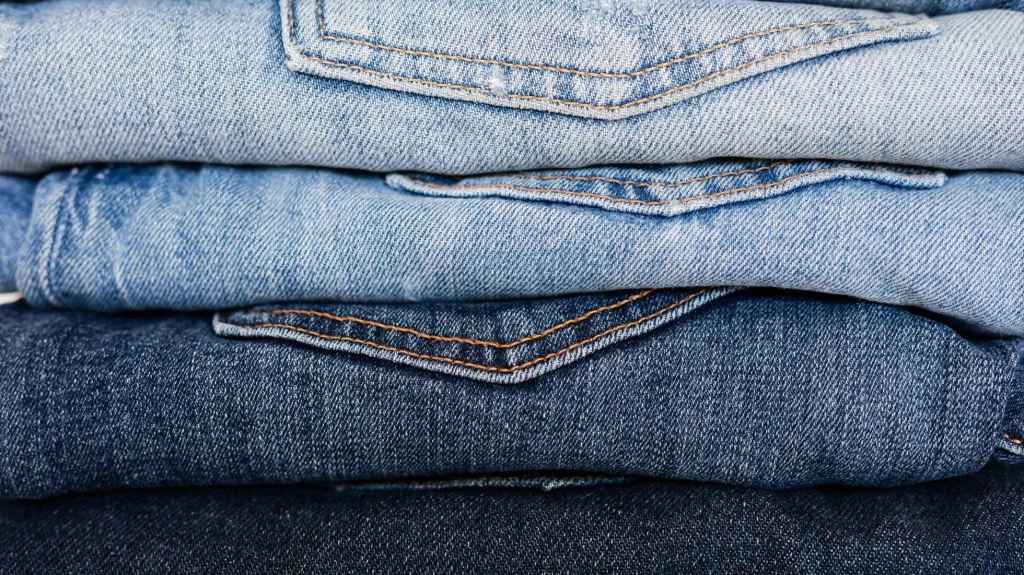
There is a good chance that somewhere in your home, within arm’s reach, sits a pair of blue jeans. They might be worn thin at the knee, folded in a drawer, or draped over a chair from last night. This is not an accident of fashion. It is the result of a 150-year relationship between a fabric and the people who wear it, one that has survived gold rushes, world wars, youth rebellions, and luxury runways without ever losing its grip on the wardrobes of ordinary people.
To understand why denim refuses to die, you have to start with why it was born.
A Fabric Built to Survive Work
Jeans were not designed to be beautiful. They were designed to not fall apart.
In 1873, a Nevada tailor named Jacob Davis had a problem. His customers, mostly miners and laborers, kept ripping the pockets off their trousers. The stress of carrying tools, ore samples, and other heavy items tore through the stitching at the pocket corners every time. Davis found a fix: metal rivets hammered into the seams to reinforce the weak points. The idea worked so well that he wanted to patent it, but he lacked the money to file the paperwork alone.
So he wrote to the company that supplied his denim fabric, a dry-goods merchant in San Francisco named Levi Strauss. Strauss saw the potential immediately, funded the patent application, and in 1873 the two men were granted U.S. Patent No. 139,121 for “Improvement in Fastening Pocket-Openings.” That patent is generally regarded as the true birth certificate of the blue jean.
The fabric itself, denim, already had a working history stretching back further. It descended from a sturdy cotton twill called serge de Nîmes, produced in the French city of Nîmes, which is where the word “denim” likely comes from. A related, though not identical, fabric was jean cloth, associated with Genoa, Italy, a name that eventually gave the garment its own. Both fabrics shared the same essential appeal: they were tough, cheap to produce, and could survive punishing daily labor.
That toughness was the entire point. Miners during the California Gold Rush needed trousers that could survive crouching in rivers and scraping against rock. Railroad workers needed pants that would not tear on machinery. Farmers, cowboys, and factory laborers across America needed clothing built for friction, sweat, and years of reuse rather than a single season of style. Denim, reinforced with copper rivets and stitched with the now-iconic orange thread, became the uniform of American physical labor. It was functional, unglamorous, and almost invisible as a fashion statement, because nobody was looking at workwear as fashion. It was simply gear.
For nearly seven decades, that is exactly what jeans remained: the pants of the working class, worn by people who needed durability more than they needed style.
From the Ranch to the Runway
The shift began, as cultural shifts often do, with images rather than announcements.
In the 1930s, Hollywood westerns put cowboys in denim on movie screens across the country, and city dwellers who had never touched a lasso started associating jeans with a certain rugged, independent American masculinity. Dude ranches became popular vacation destinations for wealthy Easterners who wanted to play cowboy for a week, and they went home with jeans in their luggage. The garment was slowly detaching from its original function and attaching itself to an idea.
World War II accelerated the shift in an unexpected way. Denim was declared an essential commodity for military use, and jeans worn by American soldiers stationed abroad introduced the fabric to Europe and Japan, where it took on an exotic, distinctly American appeal that had nothing to do with mining or ranching.
Then came the postwar rebels. In the 1950s, films like The Wild One and Rebel Without a Cause put denim on Marlon Brando and James Dean, and suddenly jeans meant something entirely different: youth, defiance, and a rejection of buttoned-up conformity. Some American high schools actually banned jeans in the 1950s because they were considered a symbol of delinquency. That reputation as rebellious clothing only made them more desirable to teenagers, which is a pattern that marketers would later learn to appreciate.
The 1960s and 70s pushed jeans further into countercultural territory. Hippies embroidered them, tie-dyed them, and patched them as symbols of anti-establishment identity. By the time the 1970s arrived, designers noticed that a garment associated with rebellion, youth, and authenticity had enormous commercial potential if it could be repackaged with a designer name attached. Calvin Klein, Gloria Vanderbilt, and others launched designer jeans that sold not on durability but on fit, branding, and status. A pair of jeans with the right label on the back pocket could suddenly cost far more than a suit, and people paid for it.
This was the pivot point. Denim had officially crossed from utility to identity. It no longer mattered whether the fabric could survive a mine shaft. What mattered was what wearing it said about you.
Why Luxury Fashion Fell for Denim
It might seem strange that an industry built on exclusivity would embrace a fabric literally invented for miners, but the logic makes sense once you look closer.
Luxury fashion sells stories as much as it sells fabric, and denim comes with one of the richest stories in American material culture: hard labor, rugged individualism, youth rebellion, and self-made authenticity. High fashion houses cannot manufacture that kind of history. They can only borrow it. When a luxury label puts its name on a pair of jeans, it is renting decades of cultural meaning that no amount of silk or cashmere can replicate.
There is also the matter of universality. Nearly everyone owns jeans, which means nearly everyone has an emotional relationship with the garment already, whether that is comfort, nostalgia, or self-image. Luxury brands love products with built-in emotional resonance, because it shortens the distance between seeing the item and wanting it.
And then there is scarcity engineering. Raw selvedge denim, Japanese production techniques, hand-distressing, and limited runs allowed designers to take an inexpensive fabric and dramatically inflate its price by wrapping it in craftsmanship narratives. A pair of jeans that costs a few dollars to produce in raw materials can retail for hundreds or even thousands of dollars once framed as artisanal, limited, or designer-branded. The fabric barely changed. The story around it changed completely.
The Fabric That Refuses to Fade
What makes denim’s staying power remarkable is that it has never actually needed the luxury market to survive. Even while high fashion was busy elevating jeans into status symbols, ordinary $30 pairs from mass retailers kept selling by the hundreds of millions, because the original appeal never disappeared. Jeans are still comfortable, still durable, still able to be dressed up or down, and still capable of looking better the more they are worn. Unlike most fabrics, denim visibly ages with its owner, fading and creasing into a pattern unique to how that person moves through the world. Nobody markets that as sentimentally as denim actually delivers it.
This dual identity is denim’s real secret. It can be the five-dollar-a-yard fabric that clothed Gold Rush miners and it can be the four-figure item on a runway, sometimes within the very same decade. It absorbs whatever cultural moment surrounds it: rebellion in the 1950s, counterculture in the 1970s, luxury in the 1980s, streetwear in the 2000s, sustainable “buy it for life” minimalism today. Few garments are flexible enough to mean so many different things to so many different generations while remaining, structurally, almost the same product Jacob Davis and Levi Strauss patented in 1873.
That is ultimately why denim never really dies. It was built from the start to survive wear, and it has spent 150 years proving that the same durability applies to its relevance. Trends fade. Fabrics wear thin and fall out of favor. But a material that can be both practical work gear and a symbol of rebellion, both a bargain-bin staple and a luxury statement piece, has built-in resilience that no single trend cycle can outlast. Jeans do not survive fashion. They absorb it, wear it in, and keep going.
 Ayerhs Magazine