
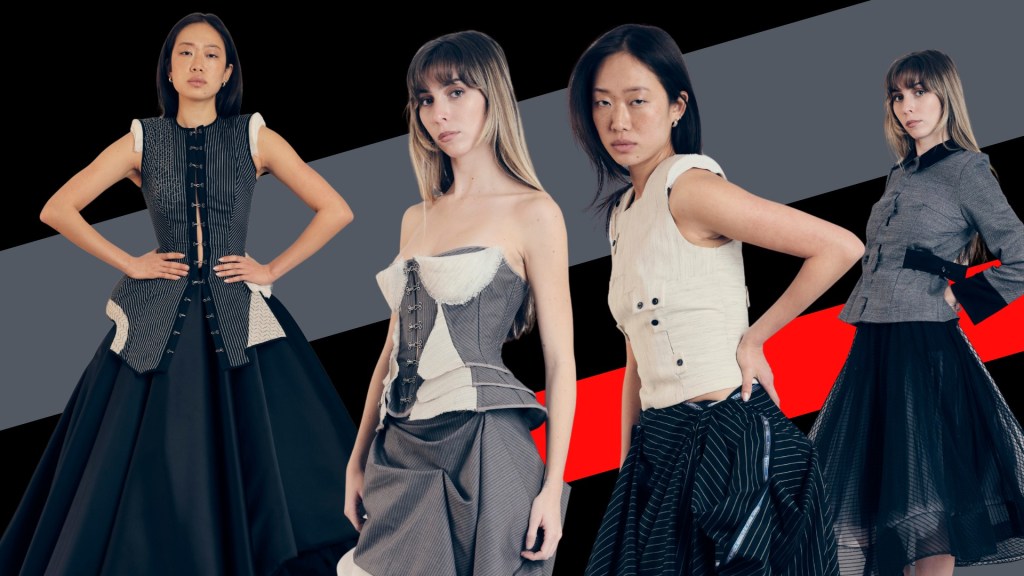
Right now everything feels filtered, smoothed out, and designed to catch your eye instantly. The internet keeps pushing this fast kind of visibility. Dopamine dressing, bright colors, loud prints, anything that can hold attention for a second while you scroll. But not everyone is dressing for that pace. Some people are dressing for something slower, more intentional. Something that asks you to actually look.
And if we are being honest, the fashion industry is not moving forward as much as it claims to. A lot of it is still built around that same need for instant attention, just repackaged in different ways.
Yuval Sorotzkin’s Work in Ruins, presented during New York Fashion Week in Williamsburg, steps outside of that cycle. It is, in its own way, dopamine dressing, but not the obvious flashy kind. These are for people who understand fashion to its truest. It reveals the construction, the cut, the fabric, the silhouette – its all out there. The “guts” of a garment are no longer something to conceal. They are the point.
Seeing the collection, what stood out immediately was how little it tried to resolve itself into something overly polished. It felt deliberate, but not over-finished. The clothes looked like they were still in conversation with themselves. That tension between control and openness is what makes the work feel current, even though so much of it draws from historical references.
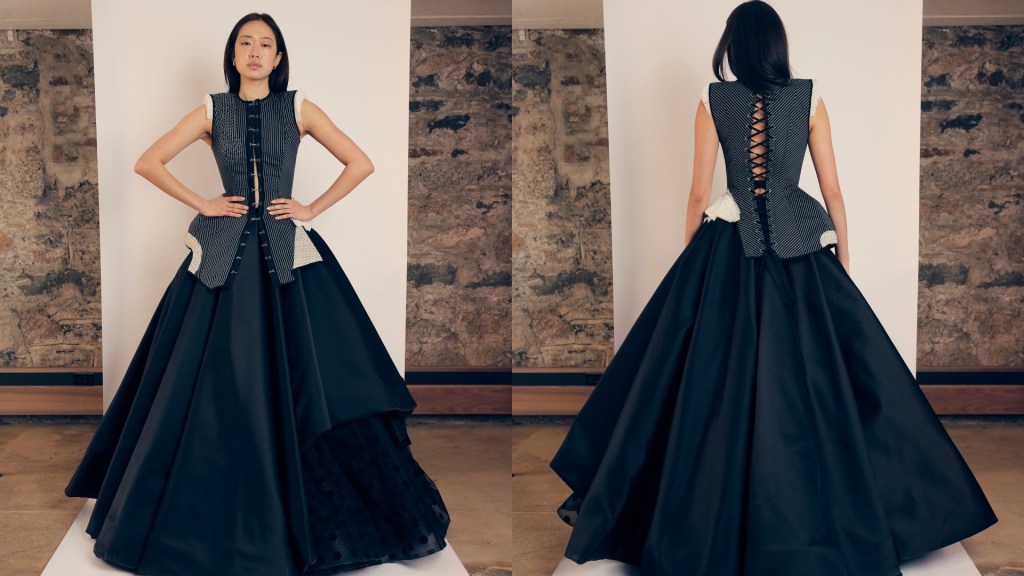
Sorotzkin introduced herself as a designer working in haute couture and eveningwear, but Work in Ruins pushes beyond those categories. It is not about occasion dressing in the traditional sense. It is about structure as emotion. About how garments are built, and what it means to let that process stay visible.
She explained that her work often begins with something internal, something emotional, which then gets translated into form. “I’m interested in translating emotional and internal experiences into physical form,” she shared, and that idea runs through the entire collection. The clothes are not just shaped around the body. They are shaped around feeling.
The concept behind Work in Ruins is rooted in exposure. Not just visual exposure, but structural exposure. Corsetry is no longer hidden. Tailoring is no longer cleanly enclosed. Padding, seams, closures, all the things that are usually tucked away are brought forward. The result is a collection that feels like it is showing you how it was made, while also asking why that process is usually hidden in the first place.
Sorotzkin’s background plays a big role in how precisely this idea is executed. She started sewing at a young age, influenced by her grandfather, a pattern maker in Paris. That early understanding of construction comes through in how the garments are built. She described pattern-making as something that works “almost like puzzle pieces,” and you can see that logic across the collection. Nothing feels random. Even the deconstruction feels engineered.
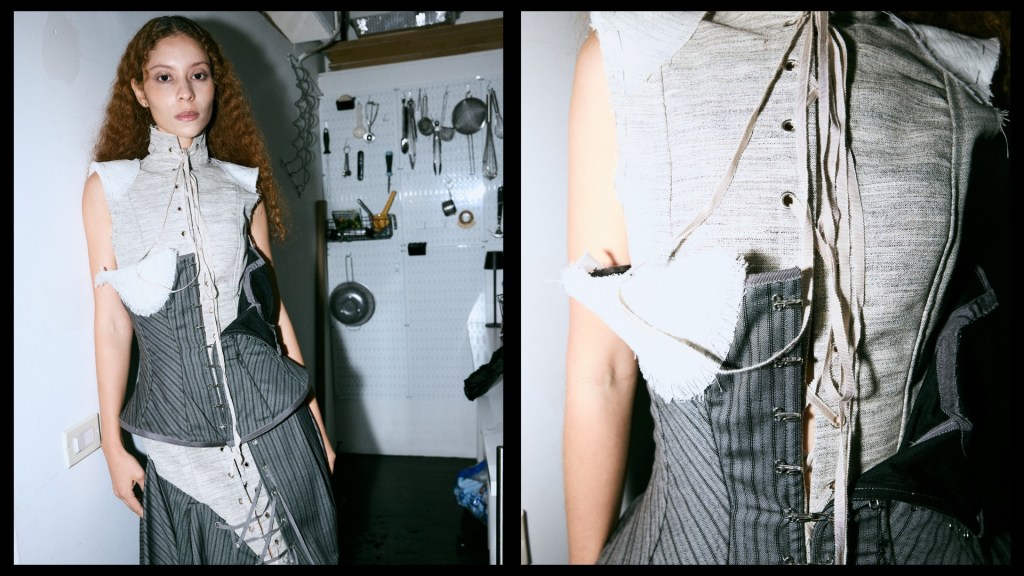
At its core, Work in Ruins is about breaking something apart and putting it back together, but not in a way that erases the break. “This collection focuses on the in-between rather than the finished result,” she said. That in-between space is where all the interesting things happen. It is where the garments feel alive.
The clothes themselves move between deconstructed tailoring and avant-garde silhouettes, blending historical corsetry with something more industrial and modern. There is a clear reference to the Victorian era, but it is stripped of softness. Instead of delicate lace and romantic drape, you get stiffness, sharpness, and a kind of controlled edge.
Corsetry is one of the strongest elements in the collection. But it is not treated as an undergarment. It is front and center. Hook-and-eye closures run down the front of bodices. Lace-up backs are exposed. The hips are exaggerated into sharp, peplum-like forms that push the silhouette into something almost architectural. These pieces shape the body, but they also reshape how we read that shaping.
What makes this especially interesting is how it intersects with traditional ideas of tailoring. Tailoring has historically been coded as masculine, while corsetry has been coded as feminine. Here those distinctions collapse. The structured jacket, the corseted bodice, the sculpted waist, they all exist within the same silhouette. It creates a space where the wearer is not confined to one category.
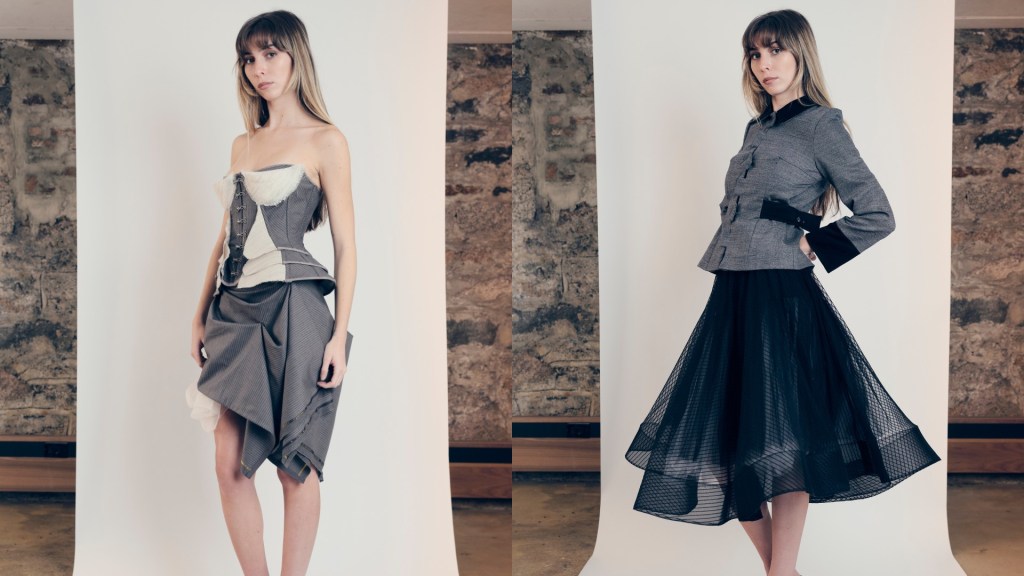
Sorotzkin was clear about this intention, explaining that the goal is to create garments where the wearer can express something personal and feel “empowered in how they present themselves.” That sense of empowerment does not come from exaggeration or spectacle. It comes from structure. From the way the garment holds the body and gives it presence.
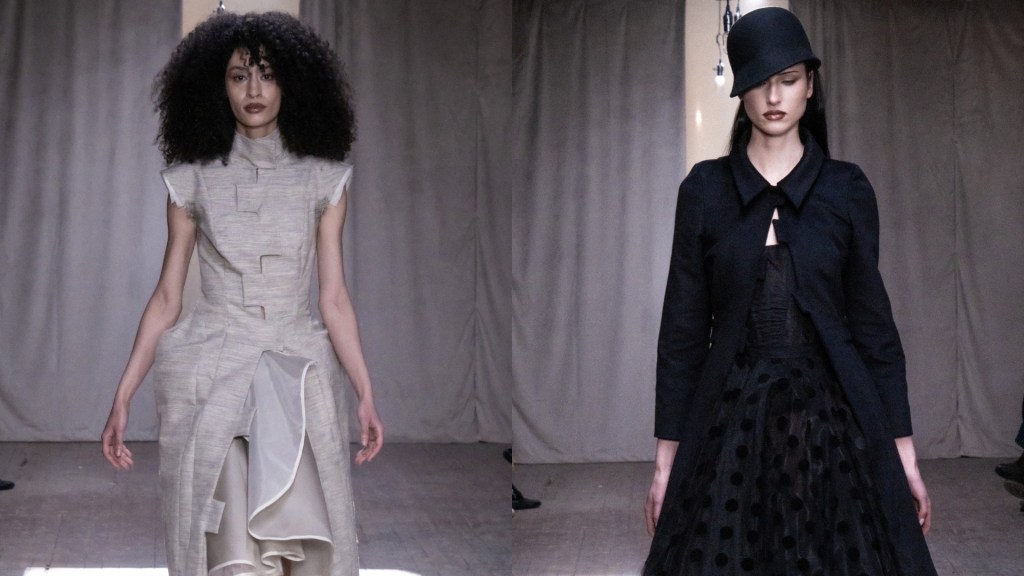
One of the standout pieces was a grey textured jacket with a high black collar and wide cuffs. At first glance, it reads like a classic tailored piece. But then you notice the disruption. A cutout at the waist creates a belted, fragmented effect. The jacket looks like it has been taken apart and reassembled. It challenges the idea of what a suit is supposed to look like, while still holding onto the discipline of tailoring.
Elsewhere, the collection leans into hybrid forms. Structured bodices paired with voluminous skirts. Asymmetrical wraps that feel like they have been built from repurposed suiting fabric. Heavy draping that adds weight and movement without softening the overall silhouette too much. These pieces feel grounded, but not static.
The materials play a big role in building that tension. There is a consistent use of darker grey fabrics, often with subtle patterns like houndstooth or tweed. Against that, raw white trims appear at the edges. They look almost unfinished, like muslin left exposed. That contrast creates a visual interruption.
There is also a strong presence of industrial hardware. Heavy hook-and-eye fastenings, metal eyelets, visible closures. These details give the collection a slightly utilitarian edge. They reinforce the idea that these garments are rugged, that they are for women who represent that strength.
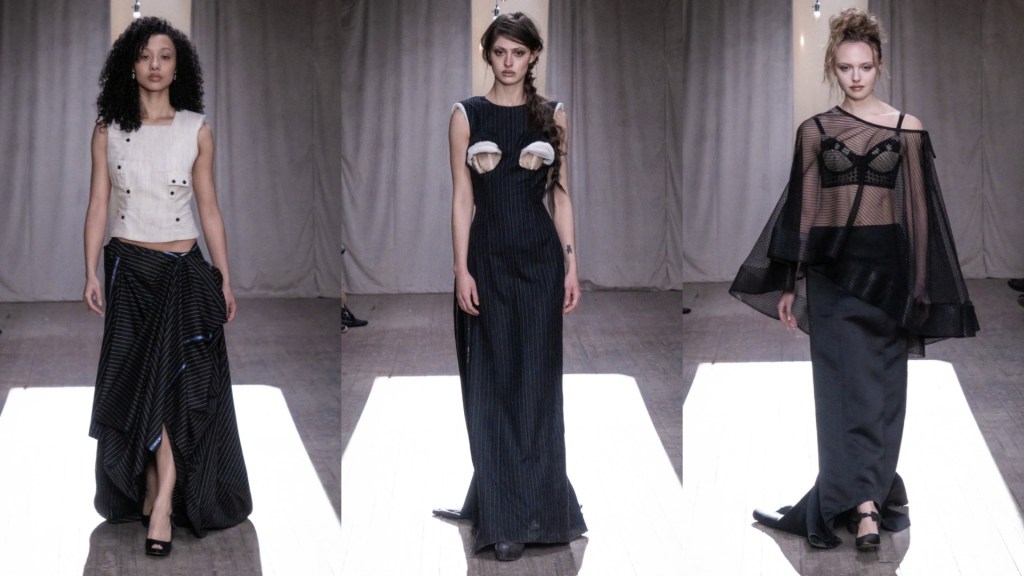
Deconstruction shows up in more literal ways too. In some pieces, padding is exposed on the chest or hips. Elements that are usually hidden inside the garment are brought out. It shifts the focus from surface to structure. You are looking into the clothes.
What keeps all of this from feeling chaotic is the level of technical control. Sorotzkin spoke about one of the most complex pieces in the collection, a deconstructed suiting corset dress with an asymmetrical petticoat and around 60 yards of fabric in the skirt. The scale of that alone is impressive, but what matters more is how it is handled. Horsehair is used to shape the form. Padding stitch reinforces the structure. Shoulder pads are hand-stitched and placed both internally and externally.
This level of detail grounds the collection. It ensures that even the most experimental pieces still feel intentional. “Even when a piece begins from a conceptual or emotional starting point, it gets resolved through construction, fit, and silhouette,” she explained. That balance is what makes the work feel complete, even when it looks deliberately unfinished.
Emotionally, the collection sits in a darker space, but it never feels heavy in a way that is overwhelming. Sorotzkin described it as a response to “pain and instability, both personal and collective,” which adds another layer to how the garments are read. They are not just aesthetic choices. They are responses.
At the same time, there is a sense of care in how that emotion is handled. The garments do not collapse under the weight of their concept. They hold themselves together. That idea comes through most clearly in how she talks about the wearer. She said she wants the person wearing the clothes to feel “both seen and safe at the same time.” That balance is not easy to achieve. Visibility often comes at the cost of protection. But here, the two exist together.
The structure of the garments acts almost like a form of support. The exposed elements do not make the wearer feel vulnerable in a negative way. Instead, they create a kind of controlled openness.
This is where this collection feels especially relevant right now. At a time when so much of fashion is focused on surface, on immediate impact, this collection asks you to slow down. To look at how something is made.
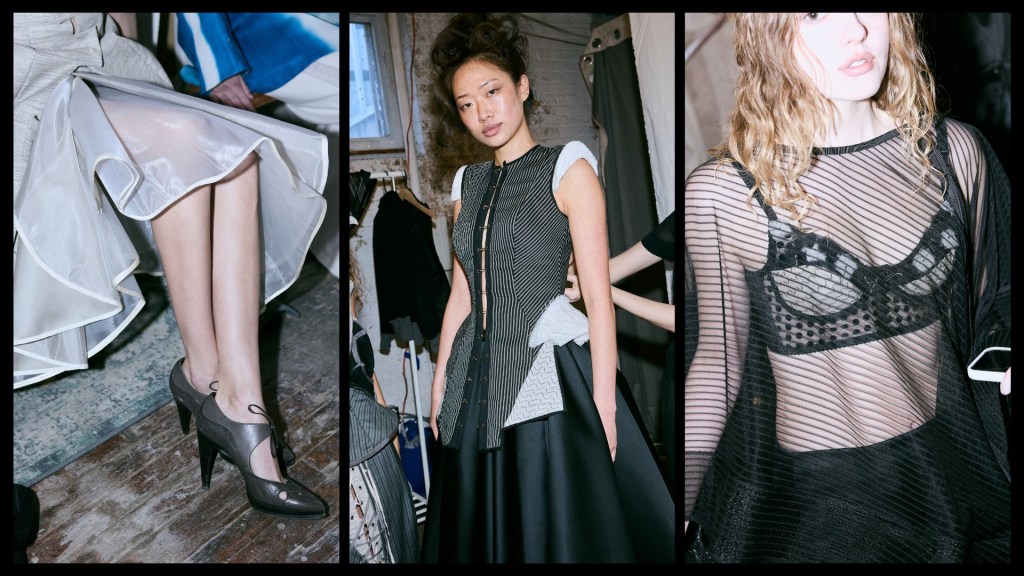
It also speaks to a broader shift happening in fashion. There is a growing interest in process, in craft, in the story behind the garment. People are starting to care not just about how something looks, but how it comes together. Sorotzkin’s work fits into that shift, but it does not feel like it is following a trend. It feels specific. It feels like it comes from a place of genuine curiosity about what clothing can do.
What stayed with me was not just a specific look or piece, but a feeling. A sense that the collection was still unfolding, even after the show ended. That it was not trying to give a final answer. There is something refreshing about work that stays open.
And this is also why we need more women designers in these spaces. There is a different kind of power that comes through when clothing is approached with this level of sensitivity to the body, to emotion, to lived experience. Here, the clothes are not just wearable. They have substance. They feel considered without being restrictive. They are easy to style, but they still hold weight. There is something democratic about that balance. It allows more people to see themselves in the work, without losing the integrity of the design.
Credits:
Featured Image + Image 1 & 3
Photography: @nicholasasotelo @portesda
Casting: @ohmygodrawni
Styling: @trecholopis
Production: @tulafaye_ @evviel @cameronirish @jasonsimoe
Talent: @michelle.lii @quinnlanreynolds
Image 2 & 5
Photography: @megmccstudio
Casting: @ohmygodrawni
Styling: @trecholopis
Production: @tulafaye_ @evviel @cameronirish @jasonsimoe
Talent: @fran.ci.ni.a @claudiasantangelo_ @makedao @michelle.lii @iisabelmontserrat
Image 3 & 6
Production lead: @tulafaye_
Production: @yuvalsorotzkin, @evviel @eclectiqnyc @cameronirish @jasonsimoe @annikahayes @ashnayakoob
Casting Director & producer: @ohmygodrawni
Casting Associate: @ranellegee
Styling: @trecholopis
Makeup Lead: @mulletxbarbie
Hair Leads: @styleclassedge @maliab0
Photography: @portesda
Lighting: @marcelblakeley
 Ayerhs Magazine