
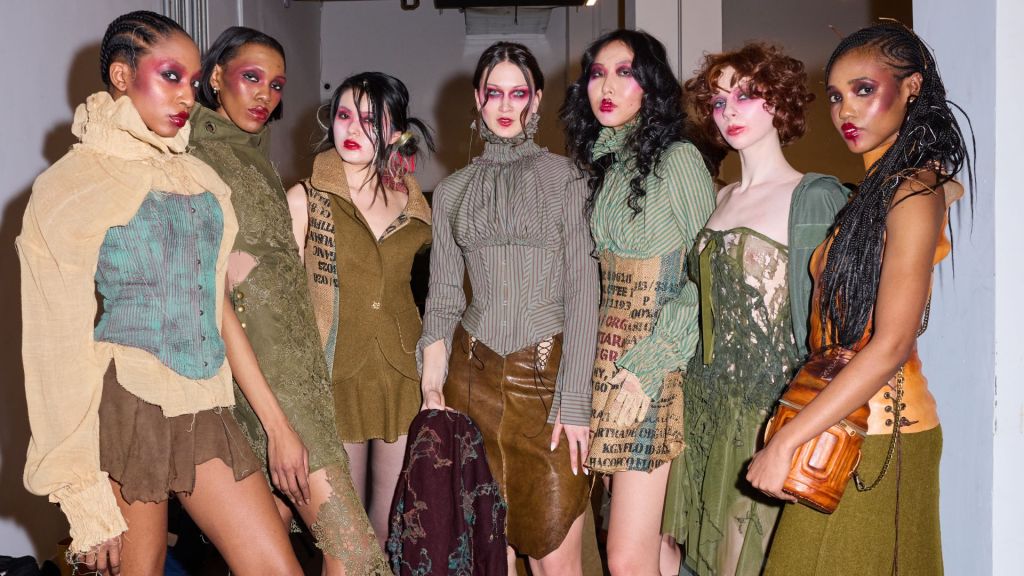
I’m just going to say it: this was one of the most underrated shows on the calendar. But why?
On the surface, yes, these are fierce hot girl clothes. Sharp tailoring, legs, attitude, silhouettes that command space. But underneath that? There’s something softer. Something almost fragile. The kind of sensuality that doesn’t scream for attention. Peleg Assulin’s outing like something else entirely — a private theatre shoved into a crowded room, where every seam and stain had a reason to be noticed. It’s quietly hot in the way of clothes that know what they are.
These pieces have story. You can see the thought in the construction, in the slightly off-kilter silhouettes that somehow fit like they belong on a real human body. There’s intentionality everywhere: the way a shoulder reads armored but still gives into something soft, how a jacket’s interior becomes almost a stage for what’s been stitched back together. It’s fashion that keeps the Theatre of Fashion alive — not as performance for its own sake but as a way to translate feeling.
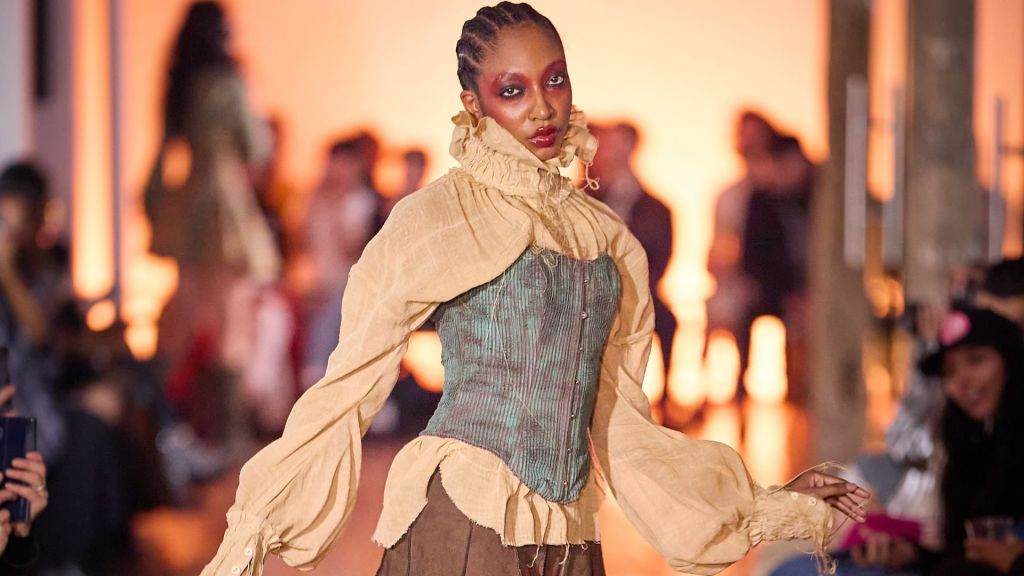
Peleg himself frames fashion as an emotional language, and that line stuck with me. “Fashion, for me, is an emotional language, direct, instinctive, and deeply human.” That’s not PR fluff, it’s a mission statement, and you can feel it in the work.
If I had to name one signature of the collection it would be tension — and not the cliché kind that most designers use as shorthand. This was a tension between survival and softness, military and intimacy, hard edges softened by careful detailing. It’s a place where utility meets desire.
Peleg described the collection as born from a very specific emotional landscape shaped by war and distance. He didn’t want to be didactic about politics, but he wanted to explore how conflict reshapes relationships and identity. That starting point matters because it makes the clothes feel like fragments of memory rather than costumes. “The collection was born from a very specific emotional landscape shaped by war and distance from home. I didn’t want to create something directly political, but rather explore a universal perspective on how conflict affects relationships and society.” That intention is stitched into the fabric of the clothes.
The military elements are obvious but not literal. Instead of pure camouflage or camo-prints, Peleg manipulates vintage uniforms and workwear, upcycling them into shapes that read as protective but also vulnerable. A jacket might look at first like classic utilitarian tailoring, then reveal soft, exposed seams and hand-dyed imperfections — the sort of detail that signals care, history, and survival, not just aesthetics.
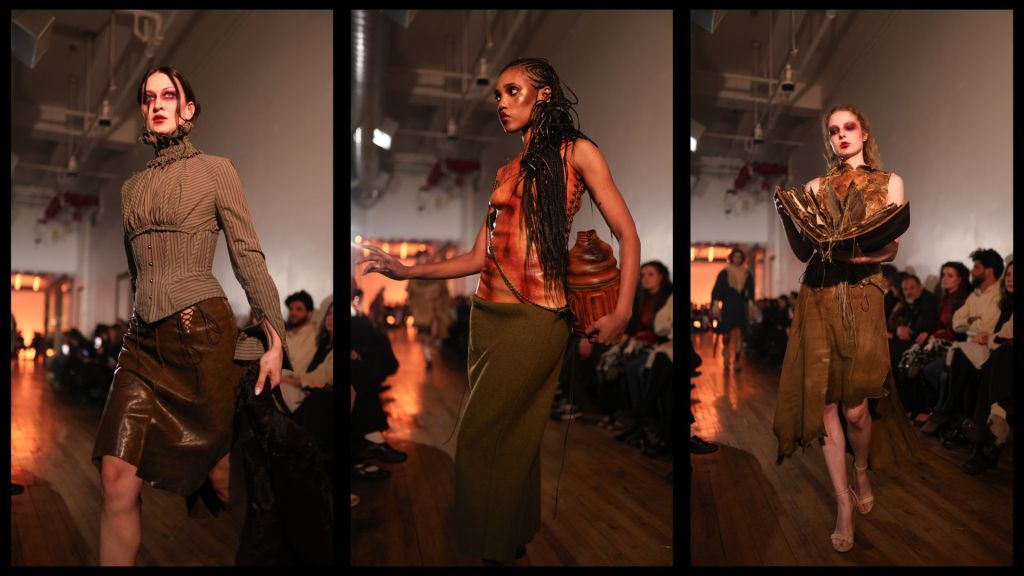
That military-to-tender transformation is what I kept thinking about on the subway home: how clothing historically meant to protect can, under a different hand, translate into tenderness. Material meant to withstand becomes material that remembers.
One of the things that stood out was the construction — the technical rigor that doesn’t feel precious. Peleg’s background in couture tailoring and costume shows. He talks about learning to dismantle garments in order to rebuild them creatively, and that skill is visible in every silhouette. “My first instinct is conceptual rather than technical. I think about the emotional role of the garment within a larger narrative. At FIT I became very focused on construction — learning how to dismantle garments in order to rebuild them creatively — so often the process starts with understanding how something is made and how it can be transformed into something unexpected.” That blend of conceptual intent and hands-on craft is a signature technique that feels like a marketable asset — a thing that sets a designer apart because it’s difficult to replicate.
But it never feels like a stunt. The shapes are interesting without being fetishized for complexity. Where some collections lean on construction for shock value, Peleg uses it to tell a story. A torso might be partially unstitched and re-layered with coffee-dyed fabric; a sleeve may be reworked into an asymmetric panel that reads both like armor and a lullaby. These are clothes that reward attention because they were built to carry memory.
There’s a soft sensual energy through the collection that I kept returning to. It’s not glossy or overly polished. Fabrics are hand-dyed with coffee and tea, and those imperfections matter. They bring warmth and an almost domestic tenderness that contrasts with the crispness of tailored lines. That combination — sober technique plus textured humanity — is a hard balance to strike, and Peleg nails it.
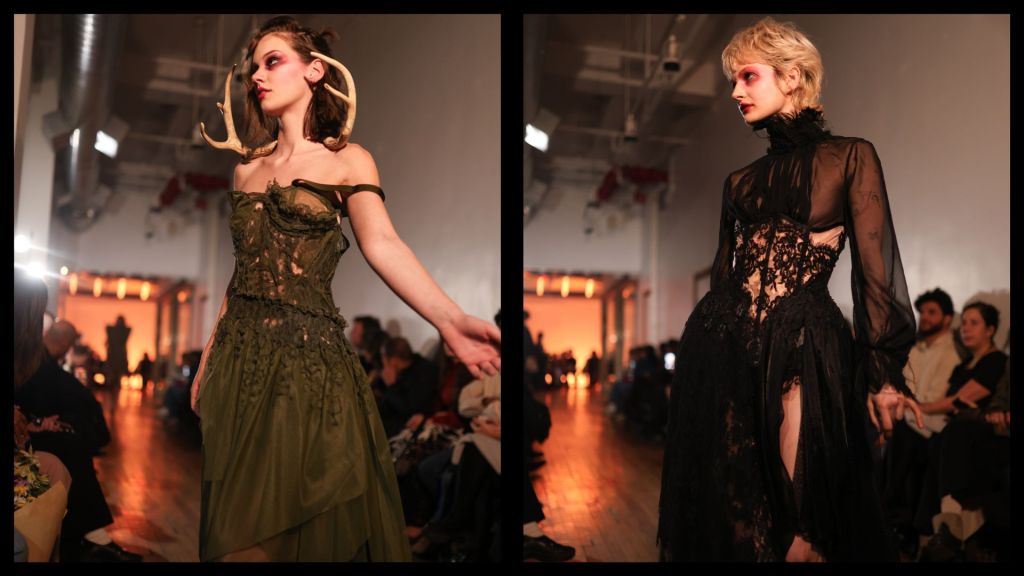
“Sustainability is not a visual trend for me; it’s an ethical foundation.” He means it. The upcycling, hand-dyeing, and use of found textiles aren’t just styling choices. They’re a framework that shapes the narrative and the look. The result is clothes that feel lived-in without feeling tired.
This is important because the industry often uses sustainability as a flavor rather than a backbone. Here, the slow processes are literally visible. Threads are mended in public-facing places on the garments. Raw edges are left as intentional markers. It reads as honesty.
I kept thinking about that phrase — fashion as an emotional language — because the collection really communicates without caption cards. Peleg says he designs garments as part of a larger narrative, each piece carrying intention and contributing to an evolving exploration of identity and resilience. That’s what the runway felt like: a sequence of chapters rather than standalone looks. “I design garments as part of a larger narrative. Each piece carries intention, contributing to an evolving exploration of identity, individuality, and resilience.”
You could walk through the show and track an emotional arc. It begins with something close to armor, moves into moments of vulnerability, then ends on a kind of fragile hope. It’s not melodramatic; it’s precise. The choreography, the sound that shifted from soft melodies to more intense crescendos, the models’ movement — these theatrical choices made the garments read as scenes in a play about people living through rupture but finding tenderness in small things.
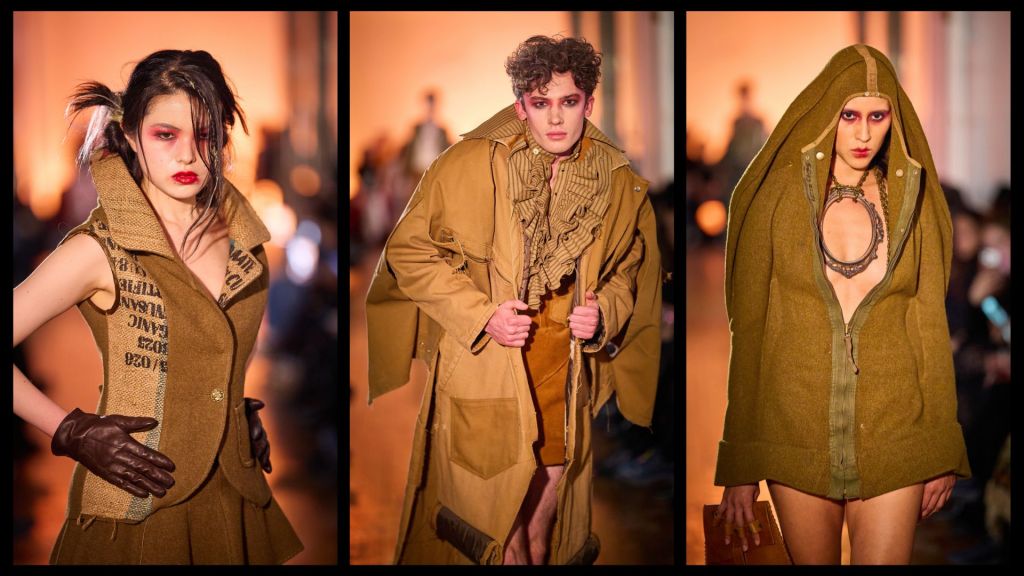
When the narrative lands like that, clothing stops being a commodity and starts acting like witness. That’s rare. It’s what makes me call this a collection with a pulse.
Visual identity is strong here in a way that feels rare for a young designer. It’s not a mood board of what’s trendy now. It’s a coherent language that you can recognize and possibly follow. The show notes even place the designer at a moment of emergence, wanting to develop a strong artistic identity rather than rush into mass production. That’s strategic and thoughtful. “Right now feels like a moment of emergence- transitioning from student to independent voice. Presenting my collection publicly and seeing people respond to it has been defining. I’m excited by the freedom to shape my own narrative and to build a world around the work that feels honest and uncompromising.”
There’s a visual throughline: the play between structured tailoring and soft, unexpected interventions; the hand-dyed patina that turns uniforms into intimate objects; the way proportions are shifted to suggest protection or exposure. It all adds up to a designer whose identity already feels like something you’d want to keep tabs on.
Call it signature technique or simply auteur energy, but Peleg’s approach gives him options. There’s clear craft that could support higher-end offerings, and there’s a narrative integrity that would make collaborations with like-minded houses believable rather than forced. That rare mix of technical skill and conceptual clarity is a marketable asset because it’s flexible. You can see how certain pieces could be adapted for atelier clients, while others could live in a small limited run that honors the upcycled process.
But there’s no sense of selling out. The designer himself is explicit that the next move isn’t immediate commercialization. He’s interested in immersive formats — performative shows and exhibition-based work — and that focus feels smart. It allows the identity to build a cultural footprint before it becomes a product machine. “I’m interested in pushing fashion further into performative and exhibition-based formats- exploring how garments interact with space, sound, and movement. The future for me is less about immediate commercialization and more about creating immersive fashion experiences that reflect my design DNA while continuing to evolve emotionally and conceptually.”
That patience is an asset. It keeps the work sharp and prevents dilution.
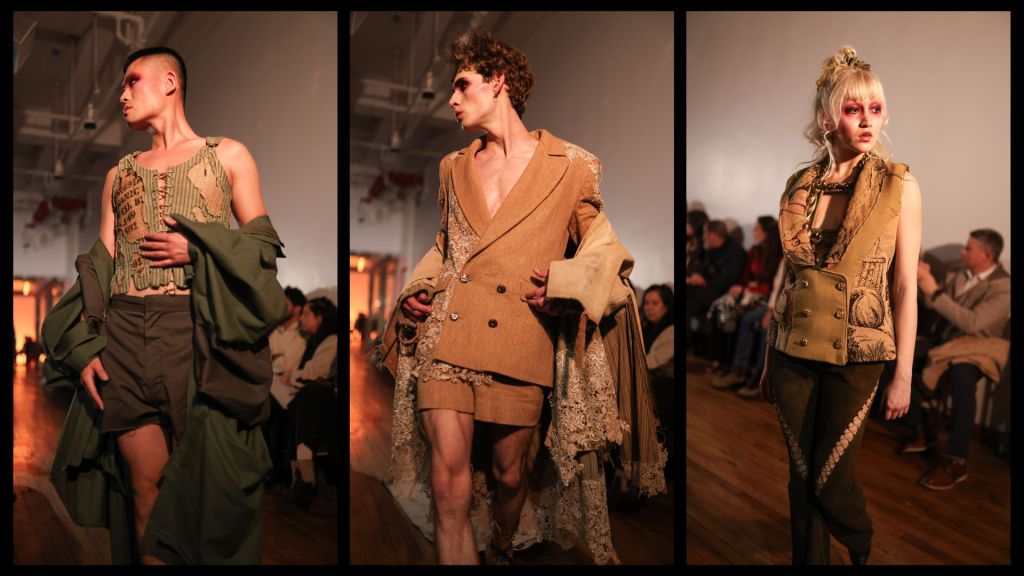
There were small things that kept pinging in my head after the show. A coat deconstructed and stitched with visible, almost tender hand-seams. A pair of trousers that looked militaristic at first glance, but on closer look had a soft underlayer peeking like a secret. A dress that seemed to float until you realized its structure was entirely carved from repurposed work shirts. These are the kinds of details that make a collection feel lived in.
I also admired the casting and choreography. The models moved in ways that made the garments breathe. The sound built in a way that felt like a spine for the show — starting intimate and growing more urgent. It all worked together to make the runway feel like a narrative rather than an inventory roll.
There’s also room to develop clearer signature motifs that can be distilled for broader visibility — a recognizable closure detail, a repeated silhouette, a specific dyeing motif. Those could act as visual hooks without sacrificing integrity. Peleg already says he’s interested in building through theatrical events and installations rather than quick production. That feels right. The work is experiential. It benefits from context.
There’s a realness here that isn’t performative. That’s rare. Peleg’s work reads as both disciplined and emotionally honest. It’s a designer voice that doesn’t shout but that you remember because the garments feel like they contain memories. That combination makes him someone to truly watch.
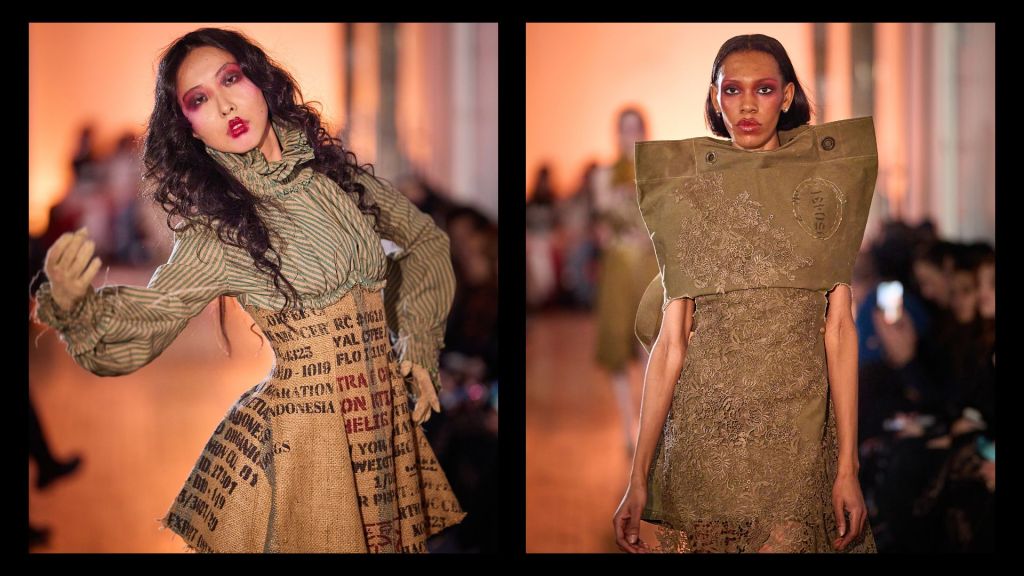
I’d go further and say he’s worth keeping tabs on. The visual identity is strong, the construction is rigorous, the sustainability practice is a backbone, and the emotional framing gives everything coherence. It’s a rare package for a designer at this stage. The show felt like the start of an archive-ready body of work rather than a seasonally disposable spin.
This was not a collection that aimed to be viral. It was quieter, smarter than that. It asked you to listen, to look, to feel. For those reasons I keep returning to the phrase soft sensual energy. The clothes are fierce, they are ready, they are sexy in a way that is human and unforced. They carry story and invite you into that story.
If you want an easy line to sum it up: this collection proves that fashion can be both marketable and meaningful without being performative. It keeps the theatre of fashion alive by using costume-level craft for emotional ends rather than spectacle alone. And to me, that is the definition of a designer who will matter beyond one season.
Peleg himself said it best when he explained why the collection exists the way it does: he hopes people remember the feeling more than a specific look. “If someone leaves thinking about the story, the music, or the emotional progression of the show, then I feel the work has resonated.” I left thinking exactly that.
 Ayerhs Magazine