
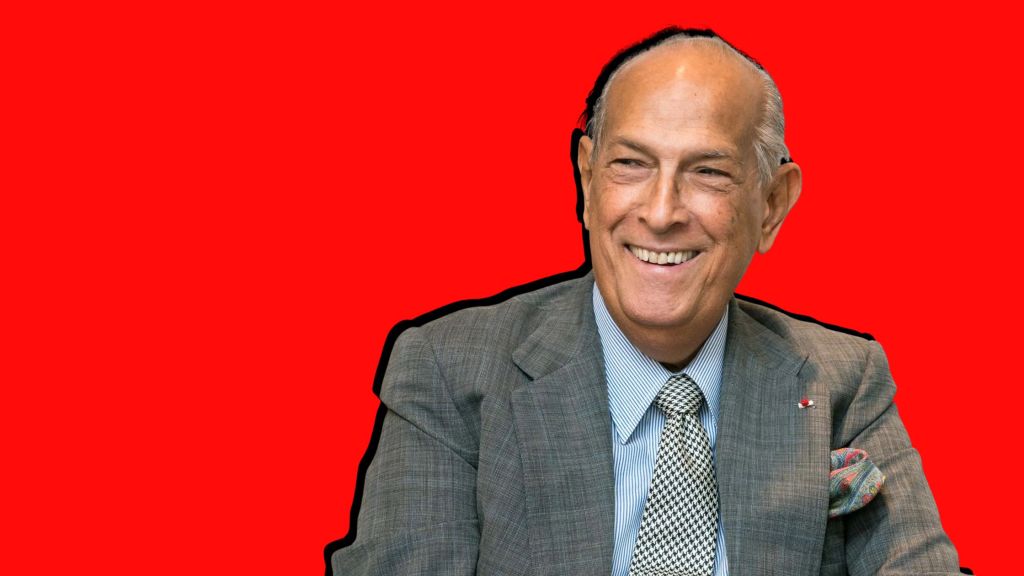
A — Art School
Before fashion became his profession, art was his focus. In the early 1950s, Oscar de la Renta left the Dominican Republic to study painting at the Real Academia de Bellas Artes de San Fernando in Madrid. His classical training shaped how he approached clothing later. He understood proportion, color harmony, and composition long before he constructed a gown. Fashion, for him, always carried the discipline of fine art.
B — Balenciaga
Training under Cristobal Balenciaga was foundational. Balenciaga’s atelier operated with near-surgical precision. Structure mattered. Silhouettes were architectural. From him, de la Renta learned restraint and technical rigor. Even when his own work leaned romantic or decorative, the internal construction reflected that early discipline.
C — Couture
Couture defined his standards, even when he worked in ready-to-wear. De la Renta never separated glamour from craftsmanship. Whether designing for private clients or department stores, he maintained a couture mindset. Seams were clean, proportions deliberate, embellishments controlled. His understanding of couture elevated American eveningwear during a period when Paris still dominated perception.
D — Dominican Republic
Born in Santo Domingo in 1932, his Dominican heritage remained central throughout his life. The colors, textures, and sense of ceremony embedded in Caribbean culture influenced his aesthetic. Later, he invested heavily in philanthropy in Punta Cana, funding schools and community initiatives. His identity was never detached from his origins.
E — Elizabeth Arden
In 1963, he moved to New York to design couture for Elizabeth Arden. This position introduced him to the American market. Unlike Parisian couture clients, American women sought polish with practicality. He adapted quickly, learning to blend European elegance with American mobility.
F — First Ladies
Few designers dressed as many First Ladies as de la Renta. Jacqueline Kennedy Onassis wore his designs after leaving the White House. Hillary Clinton and Laura Bush also turned to him. His appeal crossed political lines. His clothes projected dignity without excess, which made them ideal for diplomatic visibility.
G — Gowns
Evening gowns became his signature. Structured bodices, intricate embroidery, and sweeping skirts defined his red carpet presence. While trends shifted toward minimalism in the 1990s, he continued refining romantic silhouettes. His gowns were rarely experimental. They were polished, intentional, and camera-ready.
H — Heritage Houses
In 1989, he became creative director of Balmain, making him the first American designer to lead a French couture house. The appointment confirmed his global credibility. He respected Balmain’s heritage while modernizing its lines, commuting between Paris and New York for over a decade.
I — Industry Leadership
De la Renta served as president of the Council of Fashion Designers of America twice. His leadership helped formalize the American fashion calendar and strengthen institutional support for emerging designers. He understood that influence extended beyond the runway.
J — Jet-Set Clients
From the 1960s onward, he dressed society figures who defined international social life. His clientele included philanthropists, heiresses, and cultural leaders. He understood that these women required wardrobes for galas, state dinners, and charity events. He designed for visibility without spectacle.
K — Kent, Connecticut
Later in life, he lived in Kent, Connecticut, where he balanced work with relative privacy. Even while undergoing cancer treatment after his 2006 diagnosis, he continued designing from his home studio. Work remained central until his final months.
L — Lanvin
Before New York, he refined his skills at Lanvin in Paris under Antonio Castillo. There, he learned how couture functioned commercially. Paris taught him structure and business simultaneously, preparing him for independence.
M — Marriage
He married Françoise de Langlade, a French Vogue editor, in 1967. Her cultural network strengthened his European ties. After her death, he married Annette Engelhard in 1989. His personal life remained relatively private, though his marriages connected him to influential international circles.
N — New York
Launching his own label in New York in 1965 positioned him within a growing American fashion scene. Unlike avant-garde designers, he built his reputation on consistency. He focused on elegance that translated from runway to real life.
O — Ornamentation
While many American designers embraced minimalism, de la Renta maintained decorative richness. Embroidery, lace, and layered textures appeared consistently in his collections. Yet the ornamentation never overwhelmed structure. Decoration served silhouette.
P — Philanthropy
He invested significantly in education initiatives in the Dominican Republic. His support for schools in Punta Cana reflected long-term commitment rather than symbolic charity. He saw philanthropy as responsibility, not branding.
Q — Quiet Authority
De la Renta rarely sought controversy. His authority came from steadiness. He avoided shock tactics, preferring evolution over disruption. In an industry often driven by spectacle, his measured presence became part of his brand identity.
R — Red Carpet
By the 1990s and 2000s, he was a dominant red carpet figure. Actresses frequently selected his gowns for major award ceremonies. The designs photographed well and translated across media. He understood the visual economy of televised fashion moments.
S — Succession
In 2014, he appointed Peter Copping as creative director to ensure continuity. The decision reflected strategic foresight. He wanted the house to maintain its identity beyond his lifetime.
T — Transatlantic Career
His career spanned Santo Domingo, Madrid, Paris, and New York. Few designers moved as fluidly between these fashion capitals. This mobility allowed him to blend European technique with American pragmatism.
U — Understanding Women
De la Renta often emphasized that designers must know the women they dress. His clothes were built for social interaction, movement, and longevity. He designed for clients who attended events, led charities, and navigated public life.
V — Visibility
From magazine covers to state dinners, his work consistently appeared in high-visibility spaces. Rather than chasing youth culture, he maintained relevance by serving established influence. His brand identity remained stable across decades.
W — Wedding Gowns
In 2014, he designed Amal Alamuddin’s wedding dress for her marriage to George Clooney. The lace gown became one of the most discussed bridal designs of the decade. It reaffirmed his authority in ceremonial dressing.
X — Cross-Party Appeal
Few designers achieved bipartisan resonance. Dressing both Democratic and Republican First Ladies demonstrated his nonpartisan standing. His aesthetic projected diplomacy rather than ideology.
Y — Youthful Beginnings
His career began not in a fashion capital but in Santo Domingo. The move to Madrid at 18 required independence and ambition. That early departure defined his trajectory.
Z — Zenith
By the time of his death on October 20, 2014, Oscar de la Renta had built a house synonymous with formal American elegance. His zenith was not a single season but decades of sustained relevance. He left behind a brand grounded in craftsmanship, cultural fluency, and continuity.
 Ayerhs Magazine