
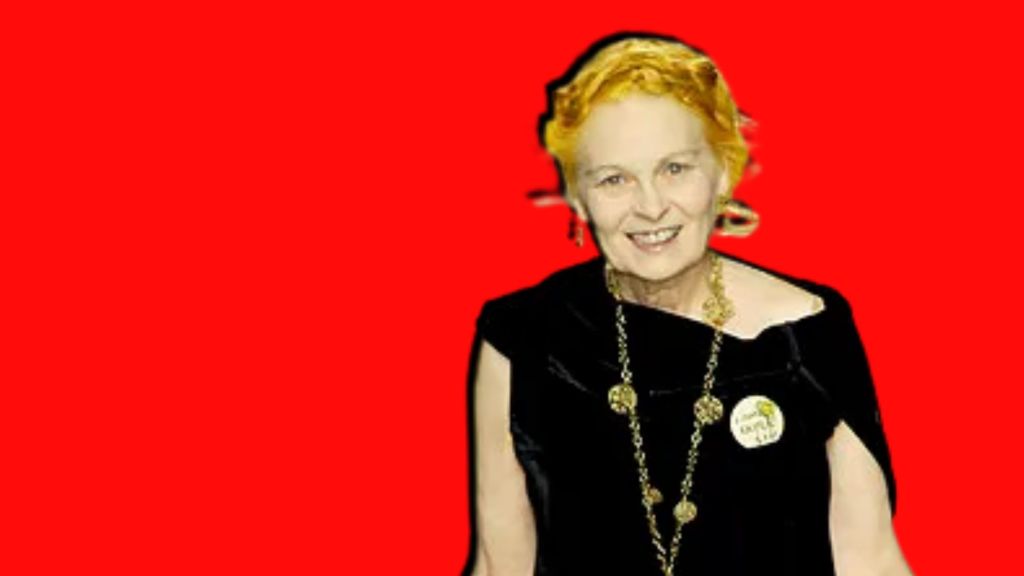
Vivienne Westwood: Fashion, Rebellion, and the Art of Dissent
Vivienne Westwood did not arrive on the fashion scene to follow rules. She arrived to rewrite them. Across more than five decades she created clothing that read as argument, theater, and history lesson. She turned subculture into couture, irony into craft, and protest into a runway language that the fashion world could not ignore. This is a detailed, chronological biography that traces how a working class girl from Derbyshire became one of the most influential and provocative designers of the modern era.
Early life and the making of an eye
Origins and family
Vivienne Isabel Swire was born on April 8, 1941, in Tintwistle, Derbyshire. The wartime context matters: rationing, patchwork living, and a culture that prized thrift and repair shaped a childhood where practical making mattered more than trend. Her father worked as a shoemaker and later in an aircraft factory. Her mother worked in a cotton mill. That working class domesticity informed Vivienne’s sense of value and materials long before she ever named it as influence.
Move to London’s outskirts
In 1958 the family relocated to Harrow, near London. The move was quiet but pivotal. London exposed young Vivienne to a wider social spectrum and the early rumblings of what would become youth culture. She enrolled briefly at Harrow Art School to study jewelry and silversmithing but left after a term. She later said she doubted people like her became artists, a comment that illuminates the class anxieties she carried into adulthood and later systemically challenged.
Teaching, making, and Portobello Road
After art school Vivienne trained as a primary school teacher. She married Derek Westwood in 1962 and had a son, Ben, in 1963. The domestic years did not extinguish creativity. She made jewelry at home and sold pieces at Portobello Road Market. That small-scale selling taught her two things: how to communicate directly with customers and how objects could carry attitude as much as function.
Meeting Malcolm McLaren and the King’s Road experiment
A partnership that rewired cultural grammar
In the mid 1960s Vivienne met Malcolm McLaren. He was a provocateur, a manager, and a conceptualist who saw potential in culture as commodity and spectacle. Their relationship was intimate and collaborative. McLaren brought theory and a taste for scandal. Westwood brought craft, eye, and a willingness to make garments that were statements more than clothes.
The shop that kept changing names
The couple opened a boutique at 430 King’s Road in Chelsea in the early 1970s. Over time the shop cycled through identities – Let It Rock, Too Fast to Live, Too Young to Die, and eventually SEX. Each name signaled a new mood, but the throughline was the same: clothing as cultural provocation.
The King’s Road shop sold reworked historical pieces, fetishwear, and deliberately offensive graphics. It drew punks, Teddy Boys, artists, and teenagers who wanted a style that publicly rejected respectability. The space functioned as a laboratory where aesthetics, politics, and performance collided.
Dressing punk in public
When McLaren managed the Sex Pistols, Westwood made the visual vocabulary. Safety pins, deliberately torn garments, jammed slogans, and collaged images turned clothing into a public argument. The infamous God Save the Queen T shirt with the defaced portrait of the monarch is the movement crystallized – an image that was less about royalty than about class frustration and political impotence in 1970s Britain.
Punk’s visual identity was shorthand for social anger: high unemployment, limited upward mobility, and a sense that mainstream institutions were failing a generation. Westwood did more than reflect that anger. She amplified it and made it wearable.
Transition from street to runway
Letting a movement end
Punk burned hot and fast. By the late 1970s it had already begun to fragment. Instead of repeating punk’s tropes, Westwood pivoted. Her split from McLaren was both personal and creative. She enrolled at Goldsmiths to study fashion formally and graduated in 1979. The move signaled a shift: from raw provocation to historical reworking and technical rigor.
Pirates and the first major runway statements
Her 1981 Pirates collection was a radical departure. Where punk had been stripped and ripped, Pirates was layered, romantic, and referencing eighteenth-century dress as much as streetwear. It introduced billowing shirts, loose trousers, and a theatrical sense of proportion. Critics initially called it eccentric. Within the industry it marked her entry as a designer who could translate ideas into a systematic, repeatable language for runway and retail.
Craft, technique, and the revival of historical dress
Using history as material
Across the 1980s Westwood mined history obsessively. She took corsetry, crinolines, and classical silhouettes and twisted them. Her approach treated the past not as costume but as raw material. Proportions were exaggerated, understructures made visible, and timelines were deliberately mangled. The result read modern, not retro.
Corsetry reimagined
Westwood’s relationship with the corset is essential to understand. Where many saw corsets as symbols of oppression, she reconceptualized them as instruments of presence. Her corsets were outerwear, sculpture, and posture devices. They created a silhouette that carried agency. Worn by choice, she argued, structured garments could empower instead of constrain.
Tailoring and Savile Row references
Her tailoring paid respect to British craft even while it disrupted it. Jackets borrowed construction logic from Savile Row but played with exaggerated shoulders, off-kilter lapels, and unexpected fabric pairings. Her attention to construction underlined a belief that provocation needed craft to be convincing.
The 1980s and 1990s – establishing a fashion house
Anglomania and signature collections
By the late 1980s and early 1990s Westwood had multiple ready-to-wear lines and a clearer brand architecture. Collections like Anglomania and Gold Label cemented recurring obsessions: tartan, historical references, and a pointed critique of heritage and class. She was simultaneously celebrating British textiles and undermining nationalist narratives that treat heritage as untouchable.
Expanding globally
Westwood began showing regularly in Paris and gained international clients. Celebrities and public figures began wearing her pieces. Yet success did not blunt her critique of the industry. She repeatedly called out waste, excess, and the system’s tendency to commodify dissent.
Controversies and cultural missteps
Her career also included misfires. Provocations sometimes crossed into taste debates. Accusations of cultural appropriation, ambiguous political statements, and stunts intended to shock occasionally backfired. Westwood rarely apologized for provocation; she accepted the conversation it sparked.
Andreas Kronthaler and renewed collaboration
Meeting Kronthaler
In 1988 Vivienne met Andreas Kronthaler, an Austrian student. Their relationship evolved into marriage in 1993 and a long creative partnership. Kronthaler’s influence nudged the brand toward new formal experiments while Westwood continued to set an ideological course.
A two-person creative engine
Together they balanced archive-driven concepts with studio experimentation. Kronthaler often handled tailoring and technical details while Westwood supplied concept and edit. This partnership allowed the house to evolve without losing its philosophical backbone.
Politics, climate, and fashion advocacy
From punk protest to environmental campaigner
From the early 2000s Westwood’s public voice shifted increasingly toward environmental and political activism. Her criticisms of consumerism and fast fashion were persistent and unapologetic. The slogan Buy less, choose well, make it last summed up a practical manifesto for sustainability before the term was mainstream in fashion discourse.
Public stunts with purpose
Westwood’s activism was performative because performance drew media. She protested fracking, contributed to climate campaigns, and staged runway moments that mimicked protest. She delivered a giant birdcage to Downing Street to dramatize wildlife decline. These gestures could be theatrical, but they were rooted in long-term campaigning and financial support for NGOs.
Critique of market hypocrisy
She accused the industry of greenwashing and urged designers to focus on longevity and repair. Her critique was aimed both at corporations and consumers. She wanted fashion to be more honest about its environmental cost.
Technique, materials, and design philosophy
Respect for textiles
Westwood had a clear material ethic. She loved British textiles such as Harris Tweed and tartans but was not bound to them. She mixed techniques and sourced fabrics that could bear structural transformation. Her collections often highlighted the textile as the foundation of meaning.
Pattern, proportion, and the art of imbalance
A repeated signature was deliberate imbalance – sleeves that did not match, hemlines that skewed, and proportions that questioned standard silhouette logic. That imbalance created tension and attention. Models did not simply wear clothes; they broke into them.
Costume, theater, and runway storytelling
Her shows were performances. Runways were stages for history lessons, satire, and political sermon. She used props, choreography, and theatrical set designs to contextualize garments. When she presented a tartan collection, the runway read like an essay on colonial history as much as it read like a fashion event.
Business realities and brand development
Scaling without losing the thread
As Westwood became a global brand, commercial realities grew. Retail partnerships, licensing, and global distribution challenged creative control. Westwood fought to keep brand identity intact, resisting cheapening of concept into mere trend.
The paradox of a rebel brand
There is an irony in being a subversive icon whose brand sells globally. Westwood reconciled this by keeping creative oversight tight and by using commercial success to fund activism. The brand’s visibility helped her voice reach beyond catwalks.
Personal life, relationships, and ideology
Family and private life
Vivienne’s personal life was complex. Her marriage to Derek Westwood early on, the subsequent partnership and break with Malcolm McLaren, and her later marriage to Andreas Kronthaler reflect different chapters of life and influence. She had a son, Ben Westwood, and was a mother and stepmother at various times while maintaining a public persona that could be unsettlingly candid.
Political commitments and public persona
Westwood was clear-eyed and outspoken. She identified with leftist politics and often aligned with environmental and human rights causes. Her public persona was both performative and sincere: a designer who used spectacle to make points she meant.
Awards, recognition, and contradictions
Institutional honors
Despite her outsider origins, Westwood received mainstream recognition. She was awarded multiple British Designer of the Year prizes and was made a Dame for services to fashion. She accepted honors in ways that often included a subversive flourish, reminding observers that institutions can be both platforms and targets.
Living with contradiction
Westwood’s life was full of paradox: she criticized consumerism while running a profitable fashion house, she condemned establishment power while accepting honors from it. She embraced these contradictions rather than smoothing them away. For her the tension was evidence of thoughtfulness rather than failure.
Later work, archives, and the final public chapters
Teaching and mentoring
In later decades Westwood embraced education. She lectured, mentored young designers, and insisted that fashion students read history, politics, and literature. She believed design needed depth beyond trend cycles.
Archival work and museum shows
Major institutions mounted exhibitions of her work, treating her output as cultural history. Shows contextualized what had once felt ephemeral – punk T shirts and couture corsets – as artifacts of social change. The archival embrace confirmed her status as both designer and cultural author.
Final collections and archival tributes
Even as her health later declined, Westwood continued to shape collections alongside Kronthaler. The house produced shows that remixed archival motifs and reinterpreted them for new audiences. After her death, Kronthaler curated tributes, and the label staged shows that read as both mourning and celebration.
Death and public reaction
December 29, 2022
Vivienne Westwood died on December 29, 2022, in Clapham, south London. She was 81. She died surrounded by family. The timing felt sudden to many, though she had been active in public and creative life well into her later years.
The conversation that followed
Tributes poured in from designers, activists, models, and fans. The obituaries varied by angle – some emphasized punk, some the corsets, some the activism. The diversity of remembrances reflected her multifaceted life: designer, agitator, teacher, and public intellectual of a peculiar kind.
Influence mapped – who learned from her and how
Designers who borrowed her language
Westwood’s fingerprints are visible on many contemporary designers. Elements like visible corsetry, tartan reinterpretation, and the use of subcultural codes show up across collections. Designers who fuse politics and identity to clothing cite her as precedent.
Subculture to high fashion pipeline
She proved a pipeline from street subculture into high fashion. That path is now a staple of how trends propagate, but Westwood was one of the first to institutionalize it: make a rebellious item, test it on the street, bring it to the runway, then translate it for the shop.
Activism as design responsibility
Her insistence that fashion carries ethical responsibilities changed the conversation. While not the only voice, she was one of the loudest early advocates for sustainable practice within fashion. Her manifesto-style slogans became prompts for broader industry conversations.
Critical legacy – the good, the messy, the complicated
Lasting contributions
Westwood changed optics: she made clothes into ideas. She challenged the industry’s assumption that design was neutral. She taught that garments could be essays, and that designers could be public intellectuals.
The messier parts of a long career
Her provocations sometimes misfired. Some performances were charged in ways she did not foresee. Her rhetoric could be blunt and alienating. But the messy parts of her career are part of what made her relevant: she provoked imperfect public debate rather than offering sanitized consensus.
Institutions, archives, and future scholarship
Museums, scholars, and curators now treat her output as source material for cultural history. Her garments are studied not just for technique but for what they say about identity, class, and power in late 20th century Britain.
How to read Westwood today
Fashion as argument
To read Westwood today is to see garments as statements. Her tartans speak of empire and its aftermath. Her corsets question the politics of the body. Her punk pieces archive anger. The clothes act as prompts to ask who benefits from taste and who is excluded by it.
Sustainability and repair
Her Buy less, choose well, make it last slogan lands differently in a world that now names the crisis she warned about. It is not a cure, but it is a practical ethic. Her championing of quality textiles and repair offers a concrete alternative to throwaway consumption.
The skyline of influence
Look for Westwood’s influence in streetwear, tailoring rebirths, visible understructure, and in designers who speak publicly about politics. She left a field of visual and intellectual debris that future makers will keep reworking.
Final note
Vivienne Westwood’s life resists tidy summary because it was lived on the edge between contradiction and clarity. She was a teacher who loved scandal, a craftsperson who loved provocation, and a political campaigner who loved beauty. Her work asked uncomfortable questions and sometimes refused easy answers. For that reason she matters. Her designs will continue to appear, be quoted, irritated by, and reinterpreted, but beyond trends her real legacy is alive where fashion and argument meet. Her lesson is simple and stubborn: clothes are never neutral, and design has the capacity to change how people think about the world.
 Ayerhs Magazine