
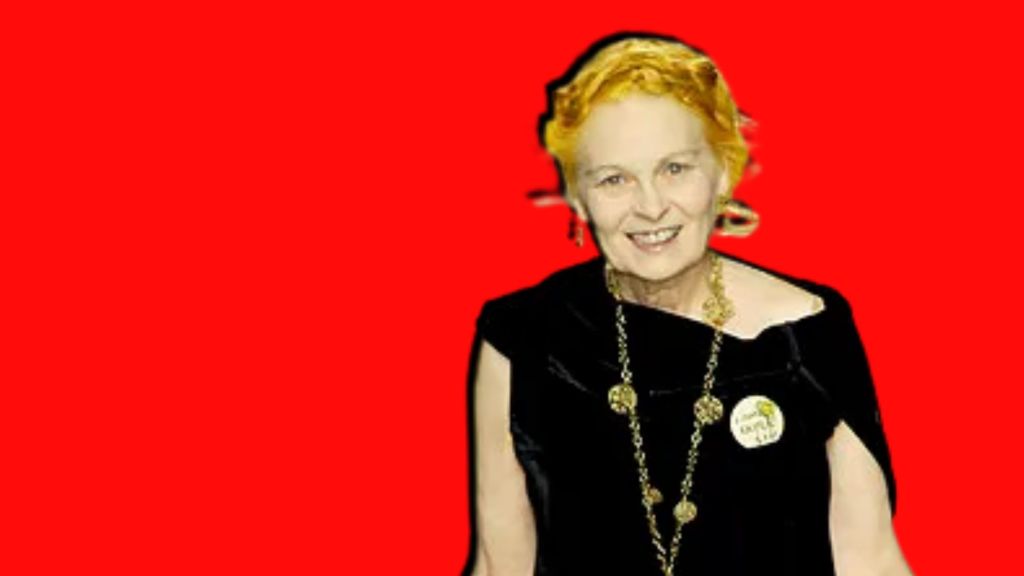
A — Activism
Activism was not a side project for Westwood. It became central to her work from the 2000s onward. Climate change, anti-fracking campaigns, civil liberties, and anti-consumerism shaped both her public voice and her collections. Fashion, to her, was a megaphone.
B — Britishness
Westwood obsessively explored British identity. From tartan and Harris Tweed to aristocratic tailoring and rural references, she celebrated and dismantled national myths at the same time. Her work questioned who Britishness is for and who it excludes.
C — Corsets
She reframed the corset from a symbol of oppression into one of agency. Worn visibly and by choice, Westwood’s corsets were about posture, power, and presence, not restriction.
D — Damehood
She was made a Dame for services to fashion, a title she accepted while continuing to criticise the establishment. Westwood embodied contradiction: inside the system while attacking it.
E — Education
Westwood believed designers should read history, politics, and philosophy. She openly criticised fashion education that prioritised speed over thinking and treated ignorance as innovation.
F — Fracking
One of her most vocal political causes. She protested fracking repeatedly, staging public demonstrations and using her platform to push environmental accountability.
G — Goldsmiths
Westwood graduated from Goldsmiths in 1979. Formal fashion education helped her translate rebellion into structure, technique, and repeatable design language.
H — Harris Tweed
A recurring textile in her collections. Westwood used Harris Tweed to explore heritage, class, and nationalism, often pairing traditional fabric with radical silhouettes.
I — Iconoclasm
Breaking icons was her specialty. From defaced monarch imagery to mocking aristocratic dress codes, Westwood treated reverence as something to interrogate, not preserve.
J — Jewelry
Before fashion, Westwood made jewelry. Early pieces sold at Portobello Road show her instinct for adornment as attitude rather than decoration.
K — King’s Road
430 King’s Road was ground zero for punk fashion. The shop’s shifting identities mirrored Westwood’s evolving politics and aesthetics, becoming a cultural landmark.
L — Let It Rock
The first incarnation of the King’s Road shop. It drew on Teddy Boy culture and 1950s nostalgia before sliding into something more confrontational.
M — Malcolm McLaren
Her most formative collaborator. Together they shaped punk’s visual identity. Their partnership fused theory, provocation, and dress into cultural disruption.
N — National Identity
Westwood treated national identity as constructed, fragile, and political. Her collections often dismantled romanticised ideas of nationhood and heritage.
O — OBE
She accepted her OBE in 1992 without wearing underwear, turning a formal honour into a subversive moment that instantly entered fashion folklore.
P — Punk
Punk was Westwood’s breakthrough, not her destination. She gave the movement its visual language, then refused to be trapped by it.
Q — Queen Imagery
Her use of Queen Elizabeth II’s image in punk graphics was about power, not monarchy. It challenged who gets represented and who controls national symbols.
R — Rebellion
Rebellion ran through everything she did. Sometimes loud, sometimes intellectual, but always intentional. For Westwood, fashion without resistance was decoration.
S — Sex
The shop SEX defined an era. It challenged censorship, sexual norms, and good taste, using clothing as provocation and social critique.
T — Tailoring
Westwood studied Savile Row traditions deeply. Her tailoring exaggerated proportion and balance, proving that rebellion works best when backed by craft.
U — Understructure
She loved revealing what fashion usually hides. Corsets, boning, and foundations were exposed to show how clothes are built and how bodies are shaped by design.
V — Vivienne
She kept her married name after divorce, turning it into a brand, an identity, and eventually a symbol larger than the individual herself.
W — Womenswear
Westwood’s womenswear challenged how femininity is defined. Her clothes suggested women could be theatrical, intellectual, aggressive, and sensual at once.
X — X-Ray Vision
A way to understand her approach. She wanted viewers to see beneath surfaces, whether in clothing construction, history, or political systems.
Y — Youth Culture
From Teddy Boys to punks, Westwood always understood youth culture as a political force. Young people were not just consumers, but carriers of change.
Z — Zeros
She often spoke about starting from zero, stripping ideas back to fundamentals. Her work repeatedly dismantled and rebuilt fashion from its foundations.
 Ayerhs Magazine