

There is a certain tension that comes from making work between geographies. Aditi Srivastava’s narrative capsule collection exists in that in-between space. Grounded in Indian textiles, sari draping, and heritage metalwork, yet informed by the grit, rebellion, and gothic subcultures of New York, her garments explore what happens.
At its core, this body of work explores the reshaping of Indian identity in the aftermath of colonization. Aditi weaves together pearls, sari-inspired draping, and heritage Banarasi silks with Victorian corsetry, safety pins, and Tudor-era veils and hoods. The result is not fusion for the sake of novelty, but a deliberate collision of histories. Indian and British, softness and restraint, ornament and utility. Through these garments, she tells a story rooted in identity, resilience, power, resistance, and survival.
Aditi’s relationship with creativity began early. She has been drawing for as long as she can remember, with art becoming a way to process emotion and belief, to give form to things that could not always be articulated. Creativity, for her, was never a phase or a hobby. It was a constant presence, showing up through literature, dance, and the fine arts. Growing up South Asian, this inclination toward the arts came with conditions. Her parents encouraged her creative pursuits, but with the expectation that they be applied in practical ways. Fashion eventually became that intersection.
She began with fashion illustration, drawn to the way clothing could function as both image and object. What pulled her in fully was fashion’s ability to hold contradiction. It could be emotional and technical, poetic and commercial. Over time, design became her primary language.
Indian references appear in Aditi’s work not as conscious insertions, but as organic echoes of memory. She speaks often about Hyderabad, her hometown, and how its textures have quietly shaped her visual vocabulary. As a child, she wandered through the markets near Charminar, absorbing colour, metalwork, and density. The layered chaos of stalls, the shimmer of bangles, the oxidised darkness of jewellery, the sound of bells chiming against each other. These impressions resurface in her work through dense surfaces, dark metals, and intricate handwork.
Sarees, in particular, occupy an emotional and visual space in her design practice. The tapestry-like quality of the textile, its ability to carry narrative through pattern and pleat, reminds her of her mother’s saree collection, built slowly over decades. Even when she is not directly referencing a saree, its logic finds a way into her silhouettes. Fluid draping, soft falls, pleats that feel intuitive rather than engineered. There is something fairy like in the way her garments move, a sense of myth and femininity.
Relocating to New York added another layer to her identity as a designer. The city’s grit, rebellion, and openness to subculture began to shape her work in unexpected ways. Within weeks of being there, she found herself drawn to punk and gothic aesthetics. These spaces, rooted in resistance and nonconformity, felt liberating after growing up in a strict and conservative school environment. Loud metal, darkness, and deliberate provocation offered a form of freedom.
For a period, Indian influences receded from her work. This was not rejection, but a conscious attempt to decolonize her approach to fashion. To unlearn expectations of what Indian design should look like, especially in a Western context. Over time, though, this distance allowed clarity. This collection marks a turning point where Aditi begins to reconcile her South Asian heritage with the dark, romantic, and macabre qualities she found herself drawn to in New York. The interplay between Indian references and gothic aesthetics becomes a space of possibility rather than conflict.
Intention, sustainability, and storytelling sit at the center of her process, and this collection is perhaps the most distilled expression of that ethos so far.
Her interest in colonization and its aftermath is deeply tied to the present moment. In a socio-political climate where identity is constantly negotiated, politicized, and contested, she found it impossible to ignore the histories that shape where and how we exist. Both her grandmothers grew up in colonial India, making the narratives of power, resistance, and survival personal rather than abstract. This lineage informed her desire to examine how identity is constructed, constrained, and carried forward.
The starting point for the collection was a Banarasi silk saree with silver zari floral motifs. The saree, for Aditi, is not just a garment but a symbol of resilience. It has survived centuries of political, cultural, and social upheaval, adapting continuously while remaining deeply rooted in Indian identity. That adaptability became a metaphor for survival.
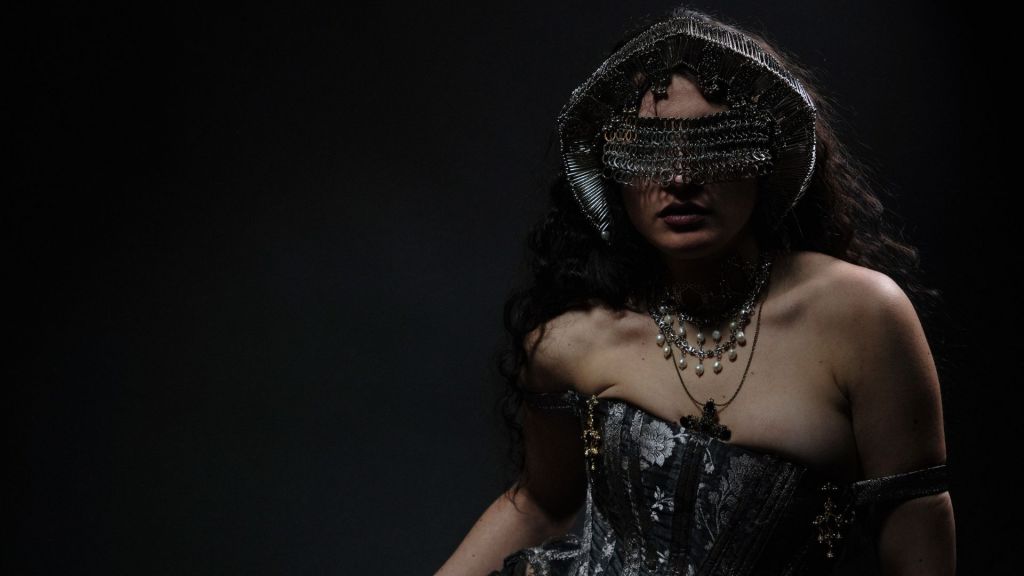
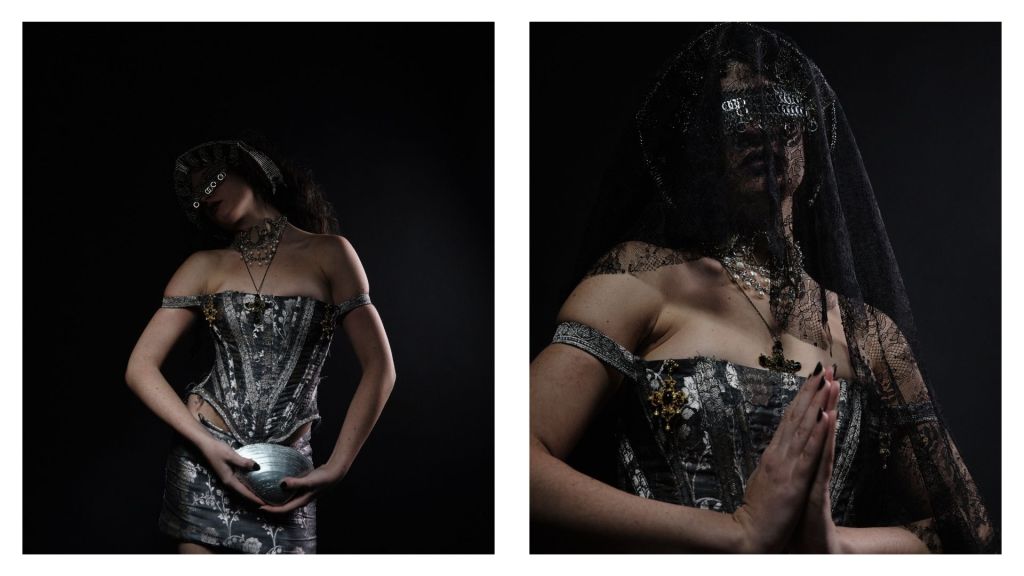
From there, she began thinking about restriction and obedience. About how control is imposed and internalized, particularly on women’s bodies. This idea manifests most clearly in the second look, where Banarasi silk is manipulated into an English-style corset. The boning channels are left raw and shredded, creating a visual tension between structure and decay. It is constricting, yet visibly unstable. For Aditi, this reflects the female experience in India, where autonomy often exists in negotiation with limitation, and freedom is something fought for daily.
The corset is paired with a gabled hood, referencing Tudor silhouettes associated with Catherine of Aragon and Anne Boleyn. Despite their privilege, both women became symbols of lost agency and constrained identity. Aditi constructs the hood entirely from wire and safety pins, embellishing it with oxidised jewellery and pearls. The washer blinder and lace mourning veil further reinforce themes of obscured selfhood and imposed silence.
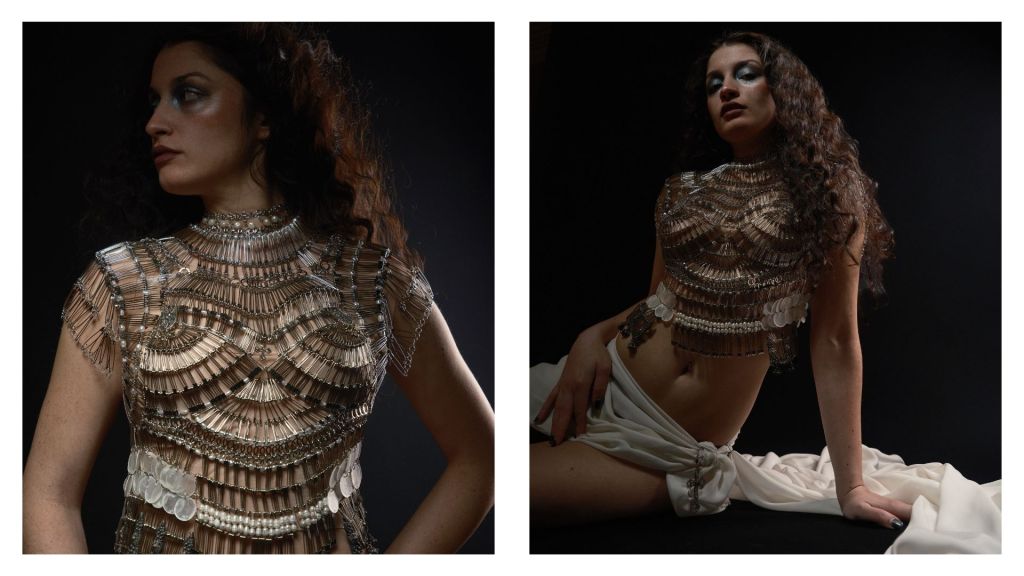
The first look offers a different but connected narrative. The hand-linked safety pin top originated from Aditi’s collection of oxidised black metal jewellery. The intricate floral details and soft chiming bells became the foundation of the piece. Safety pins entered the design process naturally, both as a practical tool and a symbol. In everyday Indian dressing, safety pins are essential to sari draping. In punk culture, they represent rebellion, chaos, and refusal. By chain-mailing safety pins together, she collapses these meanings into a single form. It is arguably the collection’s most powerful piece, one that reads as a clear flagship here.
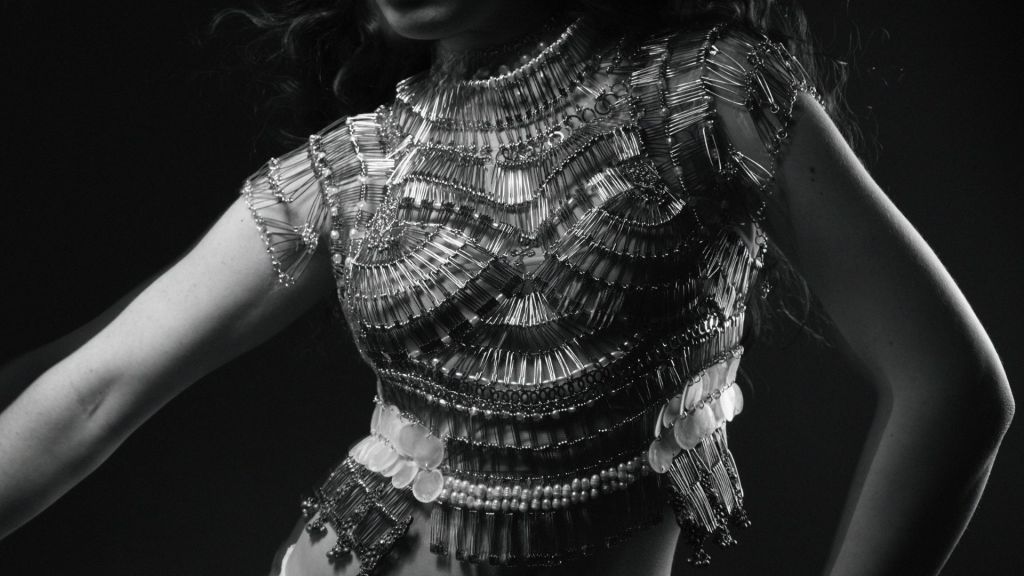
The top is accented with heritage pearls, mirror shells, and hand-linked washers. Pearls hold particular significance as a nod to Hyderabad, historically known as the City of Pearls. She sourced freshwater and glass pearls from New York, Hyderabad, and Italy, allowing the piece to carry a geography of her own movement. While the construction is symmetrical, the organic irregularity of freshwater pearls introduces softness and imperfection.
This idea extends into the accessory paired with the look, a silver chrome-plated clutch made from Atlantic clam shells. It is sculptural and unexpected, blurring the line between ornament and object. A crucifix placed at the bust serves multiple functions. It references the Anglican Church and its role in British colonization, while also drawing from punk iconography. Like many elements in the collection, it refuses to settle into a single meaning.
Handcrafted construction is central to Aditi’s technical approach. Colonization led to the erosion of many handloom practices, and she is acutely aware of the histories carried through artisan labor. By working slowly, hand-linking elements, and engaging deeply with materials, she honors those traditions while placing them in a contemporary context. The garments feel ancient and modern at once, resisting the narrow visual box that Indian fashion is often placed in.
This capsule is her most personal body of work to date, and that intimacy comes with pressure. Representation, when done carelessly, can flatten culture into aesthetic. Aditi is conscious of this risk. She believes authentic representation must retain intellectual and historical depth, re-centering South Asian stories within their political and cultural realities. For her, exoticism emerges from ignorance. By grounding her work in research, memory, and lived experience, she resists that reduction.
What makes this collection compelling is not just its visual strength, but its sincerity. It does not offer easy answers or neat resolutions. Instead, it sits with complexity. With contradiction. With the discomfort of inherited histories and evolving identities.
In encountering this work, what stays with you is not just how it looks, but how it feels. There is weight in these garments. Emotional, historical, and material. Aditi Srivastava is not interested in spectacle for its own sake. She is building a language, one that allows Indian identity to exist beyond nostalgia, beyond trend, and beyond simplification. And in doing so, she opens space for a future where South Asian fashion can be as nuanced, political, and expansive as the histories it carries.
 Ayerhs Magazine