
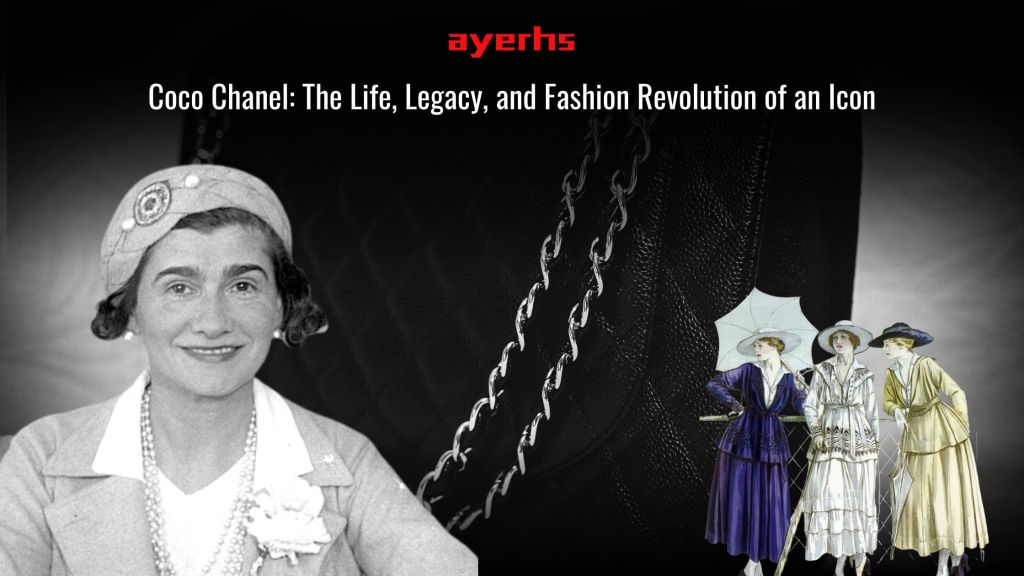
Coco Chanel is not just a name. It’s an empire. A symbol. A cultural reference point. Even if you don’t follow fashion, chances are you’ve heard of her. Maybe through the famous interlocking double C logo, the little black dress that’s now a closet staple, or the iconic No. 5 perfume. Whatever the entry point, Gabrielle “Coco” Chanel’s story stretches far beyond clothing. It’s about reinvention, resilience, contradictions, and ultimately, influence so powerful that it still shapes how we define style today.
But Chanel’s life wasn’t a fairytale of glittering gowns and Parisian soirées. It was complicated, often messy, and sometimes controversial. She came from poverty, crafted her own identity from scratch, rose to global fame, faced accusations of betrayal during the war, staged an unlikely comeback, and left behind one of the most influential fashion houses in history.
This is her story—part biography, part reflection, and part cultural exploration.
From Gabrielle to Coco: A Rough Beginning
Coco Chanel’s story began far from the runways of Paris. She was born Gabrielle Bonheur Chanel on August 19, 1883, in Saumur, France. Her father, Albert Chanel, was a peddler who sold clothing and household goods, and her mother, Jeanne Devolle, was a laundrywoman. Money was scarce, opportunities even scarcer.
When Gabrielle was just 11 years old, tragedy struck. Her mother died of tuberculosis, and her father, unable—or unwilling—to care for his children, sent Gabrielle and her sisters to a convent orphanage run by the nuns of Aubazine Abbey. The orphanage was stark and disciplined, but it was there that young Gabrielle learned to sew.
That skill, combined with her fierce determination, would become her ticket out.
The nickname “Coco” came later, when she worked briefly as a café singer in Moulins. Some say it was inspired by a song she performed, “Qui qu’a vu Coco dans le Trocadéro?” Others believe it came from soldiers who teased her with the name. She embraced it, turning “Coco” into her stage name—and later, her brand. Gabrielle the orphan became Coco the persona.
First Steps into Fashion: Hats and High Society
Coco Chanel’s first real venture into fashion wasn’t with dresses or perfume—it was with hats. In 1910, with financial backing from a wealthy lover, Étienne Balsan, she opened her first boutique in Paris, Chanel Modes, specializing in millinery. Her hats were simple and elegant, a stark contrast to the heavily feathered and decorated ones popular at the time.
The simplicity caught attention. Actresses began wearing her hats, spreading her reputation among the fashionable elite. Soon, Chanel expanded into clothing, making practical pieces from jersey fabric—material that was previously used mostly for men’s underwear.
This was Chanel’s first act of rebellion. Where others saw limits, she saw opportunity. Where society dictated women must dress as delicate, ornamental beings, Chanel designed clothing that allowed them to move, breathe, and live.
Redefining Women’s Fashion
Chanel didn’t just design clothes—she redefined women’s fashion. Her philosophy was revolutionary for the early 20th century:
- She liberated women from corsets. Gone were the days of tightly laced waists and elaborate gowns. Chanel favored relaxed silhouettes.
- She made jersey fashionable. Turning humble fabric into chic attire was a bold move that democratized style.
- She normalized trousers for women. Still considered scandalous at the time, Chanel wore and designed pants with confidence.
- She introduced the Little Black Dress. In 1926, Vogue compared it to the Ford Model T—simple, accessible, universal.
- She created the Chanel suit. A collarless jacket and skirt in tweed or wool, comfortable yet sophisticated, became the uniform of modern femininity.
Her designs weren’t just about aesthetics—they were about freedom. In an era when women were beginning to push against societal constraints, Chanel’s fashion mirrored and fueled that movement. She once said: “Luxury must be comfortable, otherwise it is not luxury.”
That statement became her signature.
Chanel No. 5: The Scent of Modernity
If her clothes revolutionized women’s wardrobes, her perfume changed the entire fragrance industry.
In 1921, Coco Chanel launched Chanel No. 5, collaborating with perfumer Ernest Beaux. Unlike other perfumes of the era, which typically featured one dominant floral note, No. 5 was complex, abstract, and modern. It used aldehydes to create a scent that felt clean, fresh, and sophisticated.
Even its presentation was groundbreaking. The bottle was minimalist and geometric, standing out from the ornate, decorative flacons popular at the time. Chanel understood branding before branding was even a buzzword.
The perfume became iconic when Marilyn Monroe declared she wore “nothing but a few drops of Chanel No. 5” to bed. With that, No. 5 transcended fragrance—it became part of culture.
Today, it remains one of the world’s best-selling perfumes.
The Carefully Crafted Persona
Coco Chanel was more than a designer. She was an expert in reinvention—of clothes, and of herself. She often edited her personal history, embellishing or obscuring details to craft a narrative that fit her image. She downplayed her humble beginnings, implied aristocratic roots, and presented herself as entirely self-made.
In truth, her success was partly fueled by relationships with wealthy men—Balsan, Arthur “Boy” Capel, and others—who provided financial support and social access. But Coco was no passive beneficiary. She used those opportunities strategically, building her independence piece by piece.
This ability to rewrite her own story made her an enigma. To some, she was a feminist icon; to others, a ruthless opportunist. The reality? She was both.
The Dark Chapter: Chanel During World War II
No account of Chanel is complete without addressing her wartime years.
When Nazi Germany occupied France in the 1940s, Chanel closed her fashion house, claiming it wasn’t a time for fashion. But while her boutiques shuttered, her personal life took a controversial turn.
She lived at the Ritz Hotel, where many German officers resided, and reportedly had a relationship with Hans Günther von Dincklage, a German intelligence officer. Declassified documents later suggested she acted as a Nazi collaborator, even taking on intelligence missions under the codename “Westminster.”
After the war, she was briefly arrested but never formally charged. Some say Winston Churchill intervened on her behalf, due to her connections with British elites. Regardless, her reputation suffered, and she exiled herself to Switzerland for nearly a decade.
This period complicates her legacy. Can a woman celebrated for liberating others in fashion also be remembered as someone who collaborated with an oppressive regime? History rarely offers simple answers.
The Comeback of a Lifetime
By the early 1950s, Dior’s “New Look” had taken over the fashion world, reintroducing cinched waists and voluminous skirts. To Chanel, it was a step backward—putting women back into restrictive clothing she had once fought to dismantle.
At age 70, Coco staged a daring comeback. In 1954, she reopened her fashion house in Paris, unveiling a collection that reintroduced the Chanel suit and her minimalist aesthetic.
The French press was lukewarm, some even dismissive. But across the Atlantic, in America, her designs were celebrated as fresh and modern. Soon, Chanel was once again at the forefront of fashion, embraced by Hollywood stars and style icons.
Jackie Kennedy, in particular, helped seal Chanel’s post-war revival. Her pink Chanel suit, worn on the day of President John F. Kennedy’s assassination in 1963, became one of the most recognizable garments in history.
Coco Chanel had not just returned—she had cemented her immortality in style.
The Final Years
Coco Chanel worked until the very end. On January 10, 1971, she passed away at the Ritz Hotel in Paris, where she had lived for decades. She was 87 years old. Even on her last day, she was reportedly preparing for her next collection.
Her funeral was held at the Church of the Madeleine in Paris. Models from her fashion house attended, dressed in her designs. The woman who had reshaped fashion for the modern woman was laid to rest, but her influence was only beginning to grow.
Chanel’s Legacy: Beyond the Woman
Coco Chanel left behind more than a fashion house—she left behind a philosophy.
- Timelessness over trend. While fashion trends come and go, Chanel’s staples—the LBD, the tweed suit, the quilted handbag—remain relevant.
- Simplicity as elegance. She showed that luxury doesn’t need excess—it needs refinement.
- Fashion as freedom. By liberating women from restrictive clothing, she aligned fashion with independence and empowerment.
Her brand lived on through successors. Most notably, Karl Lagerfeld took over in 1983, reinventing Chanel for new generations while staying true to its DNA. Under his direction, Chanel became not just a fashion house but a cultural powerhouse, blending classic tweed suits with bold runway theatrics. Today, under Virginie Viard, Chanel continues to thrive, proving that Coco’s vision was built to last.
Chanel as Icon and Enigma
The fascination with Coco Chanel isn’t just about her clothes—it’s about her contradictions.
She was a woman who empowered others but also relied on powerful men. A trailblazer who championed freedom but fraternized with oppressors. A minimalist designer who lived a life of extravagance.
This duality makes her enduringly compelling. She can be admired and criticized in equal measure. Perhaps that’s why she continues to captivate: she represents both the brilliance and the flaws of human ambition.
Why Coco Chanel Still Matters Today
In today’s world of fast fashion, micro-trends, and social media-driven aesthetics, Chanel’s philosophy feels almost radical. She believed in investing in timeless pieces, in creating style that outlives trends. In a culture obsessed with the new, Chanel reminds us of the power of the lasting.
Her story also serves as a cautionary tale about legacy. Greatness is rarely untainted. We can celebrate her genius while also acknowledging her mistakes. In doing so, we allow for a more nuanced understanding of history and its figures.
Ultimately, Coco Chanel matters because she showed that fashion isn’t superficial—it’s transformative. It’s about how clothes make us feel, how they allow us to move through the world, and how they reflect the times we live in.
Final Thoughts
Coco Chanel once said, “Fashion fades, only style remains the same.” Decades after her death, her words ring true. Her life was far from perfect, filled with reinvention, controversy, and brilliance. Yet her influence on fashion—and on the idea of style itself—is immeasurable.
To wear Chanel is not just to wear a brand—it’s to step into a philosophy. A belief that elegance is found in simplicity, that comfort is not a compromise but a necessity, and that style is as much about attitude as appearance.
Coco Chanel wasn’t just a designer. She was a storyteller, a rebel, and a visionary. She taught us that reinvention is possible, that style is eternal, and that even flawed figures can change the world.
In the end, maybe that’s the real magic of Coco Chanel: she turned her life into her greatest creation—and the world is still wearing it.
 Ayerhs Magazine