
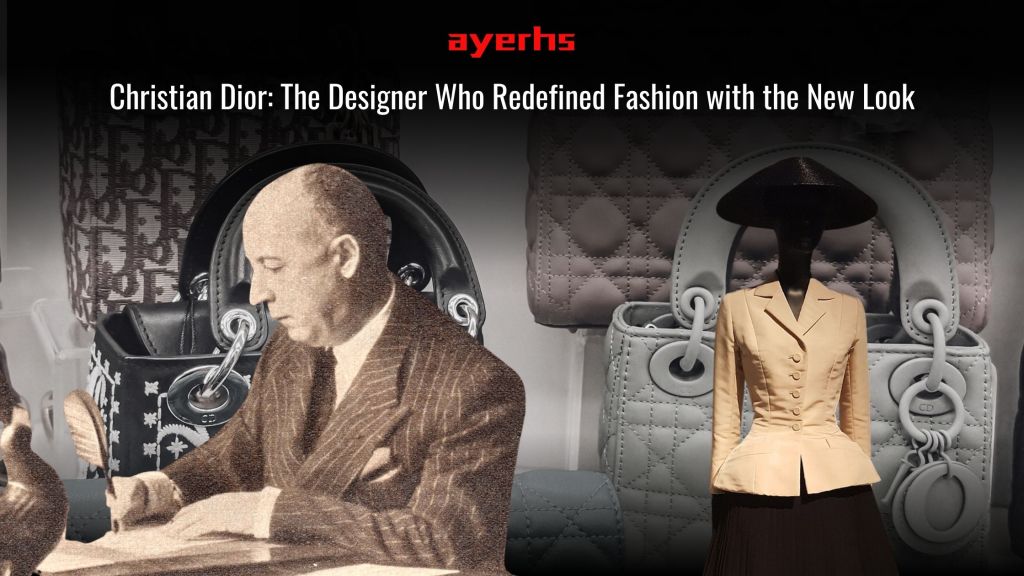
If Coco Chanel gave women freedom, Christian Dior gave them fantasy. His name is now synonymous with luxury, refinement, and haute couture. The House of Dior is one of the most powerful fashion houses in the world, but at its heart lies a man who lived only a brief life yet reshaped the future of fashion forever.
Christian Dior’s story is about revival and reinvention—of fashion, of femininity, of post-war optimism. His 1947 “New Look” didn’t just redefine women’s wardrobes, it redefined an era. He restored Paris to its throne as the capital of fashion after the devastation of World War II. And though he died at just 52, his influence is still felt on every runway, in every Dior collection, and in the way we think about elegance today.
This is the story of Christian Dior: part biography, part cultural analysis, and part reflection on why his vision still matters.
Early Life: A Childhood in Normandy
Christian Dior was born on January 21, 1905, in Granville, a seaside town in Normandy, France. He came from a wealthy family; his father was a successful fertilizer manufacturer. Dior grew up in a villa by the sea, surrounded by gardens that would later inspire his lifelong love for flowers. Roses, lilies, and blossoms often appeared in his designs, both in prints and in embroidery.
But Dior’s path wasn’t straightforward. Though he had artistic ambitions, his parents wanted him to study political science. Dutifully, he enrolled, but his heart wasn’t in it. He longed for a more creative life. Eventually, he convinced his parents to support his interest in the arts, and he opened a small gallery in Paris where he exhibited works by artists like Picasso and Dalí.
The gallery was short-lived. When the Great Depression hit, the Dior family lost much of their fortune, forcing Christian to close the gallery. For a time, he struggled financially, taking small jobs as an illustrator for fashion magazines. It was an unglamorous chapter—but it was also the beginning of his journey into fashion.
Stepping into Fashion: From Illustrator to Designer
In the 1930s, Dior began working as a fashion sketch artist. His talent for drawing elegant silhouettes caught the attention of established designers. By 1938, he was working for Robert Piguet, one of Paris’s leading couturiers. It was here that Dior learned the art of fashion design.
World War II interrupted everything. Dior served briefly in the French army, then returned to Paris after the German occupation. During the war years, he worked with designer Lucien Lelong, creating dresses for the wives of Nazi officers and collaborators—a controversial reality for many Parisian fashion houses trying to survive under occupation.
It was a morally complex time, much like Coco Chanel’s war years. But for Dior, these years also allowed him to refine his skills. By the time the war ended, he was ready for something new.
The Birth of the House of Dior
In 1946, with the financial backing of French businessman Marcel Boussac, Christian Dior opened his own couture house at 30 Avenue Montaigne in Paris. Few could have predicted what came next.
On February 12, 1947, Dior presented his first collection. The world was still reeling from the devastation of war. Rationing had left women in boxy, practical clothing. Fashion had been muted and functional. Then Dior unveiled something completely different.
The New Look: A Fashion Revolution
The collection, officially named Corolle but quickly dubbed the “New Look” by Harper’s Bazaar editor Carmel Snow, shocked and delighted the world.
The designs featured:
- Rounded shoulders
- Cinched waists
- Full, flowing skirts that fell below the calf
- Luxurious fabrics and intricate details
It was the opposite of wartime austerity. Dior’s clothes celebrated femininity, glamour, and extravagance. Women who had spent years in rationed, practical clothing suddenly had a vision of romance and beauty again.
The impact was immediate. The New Look restored Paris as the global capital of fashion, cemented Dior’s reputation as a genius, and gave women something they had been craving: elegance and joy after years of sacrifice.
Not everyone was pleased. Some critics, especially feminists, argued the New Look re-imposed restrictive ideals on women, undoing the freedom that designers like Chanel had fought for. The nipped waists and heavy skirts required corsetry and layers of fabric—hardly practical. But the allure was undeniable, and the style dominated the late 1940s and early 1950s.
Dior’s Signature Style
Beyond the New Look, Dior’s house became known for its romantic, highly constructed designs. He once said: “I have designed flower women. After women, flowers are the most divine creations.”
Flowers remained at the heart of his vision:
- Petal-shaped skirts
- Embroidered blossoms
- Floral-inspired silhouettes
Dior believed fashion should be art, beauty, and escape. His couture shows were theatrical, luxurious, and aspirational. While Chanel championed simplicity, Dior celebrated excess. And in post-war Paris, excess was exactly what many desired.
Building an Empire
Dior wasn’t just a designer; he was a businessman with vision. He understood the power of branding and expansion. Under his leadership, Dior launched:
- Perfume: Miss Dior, released in 1947, became an instant classic.
- Accessories: Gloves, hats, and handbags to complete the couture look.
- Licensing: Dior was one of the first to license his name, expanding into ready-to-wear, hosiery, and even household items.
This strategy transformed Dior from a fashion house into a global empire. By the early 1950s, the Dior label accounted for nearly half of France’s fashion exports.
The Dior Woman: Femininity Redefined
Dior’s vision of femininity was specific. His clothes celebrated curves, romance, and delicacy. He wanted women to feel like flowers, blooming in beautiful shapes and fabrics.
This vision was not without criticism. While many adored the glamour, others argued it constrained women, reintroducing restrictive clothing after years of progress. Coco Chanel famously mocked Dior’s New Look, saying: “Dior doesn’t dress women. He upholsters them.”
Yet, for millions of women, Dior’s clothes represented beauty, luxury, and escape. They weren’t meant for everyday practicality—they were meant for dreaming.
Dior’s Unexpected Death
Christian Dior’s career was brilliant but tragically brief. On October 24, 1957, while vacationing in Italy, he suffered a fatal heart attack. He was just 52 years old.
The fashion world was stunned. Dior had only been in business for a little over a decade, yet he had already become one of the most important designers in history. His sudden death left the future of the House of Dior uncertain.
The Legacy Through Successors
After Dior’s death, a young, unknown assistant named Yves Saint Laurent was chosen to lead the house. At just 21, Saint Laurent carried on Dior’s legacy while gradually injecting his own youthful vision. His 1958 “Trapeze” collection was a success, signaling that Dior would survive.
Later, other designers—including Marc Bohan, Gianfranco Ferré, John Galliano, Raf Simons, and currently Maria Grazia Chiuri—each reinterpreted Dior’s vision for their times. Each brought something new, but the DNA of Dior—the romance, the elegance, the celebration of femininity—remains.
Dior Today: A Global Symbol of Luxury
The House of Dior is now one of the most powerful brands in the luxury industry, part of the LVMH group. Its influence extends beyond fashion to perfumes, accessories, and beauty.
Runways still echo with Christian Dior’s original vision, but they are constantly evolving. Maria Grazia Chiuri, the first woman to head Dior, has brought feminist themes to the brand, merging Dior’s legacy of elegance with modern social consciousness.
The Dior name now stands not only for couture but for cultural relevance.
Why Christian Dior Still Matters
Christian Dior’s story resonates for several reasons:
- He revived beauty after war. His New Look brought joy and elegance back into a world scarred by austerity.
- He redefined luxury branding. Perfume, accessories, licensing—all strategies still used today.
- He embodied contrast. While Chanel stripped fashion down, Dior built it back up in layers of fabric and fantasy.
- He proved that fashion is cyclical. What may feel regressive to some can feel revolutionary to others, depending on the moment.
Even though his career was short, Dior’s vision permanently reshaped fashion. His brand endures not because it clings to the past, but because it reinvents it.
Final Thoughts
Coco Chanel and Christian Dior are often remembered as opposites—she gave women freedom, he gave them form. She stripped fashion to its essence, he layered it with fantasy. And yet, together, they shaped modern fashion more than any other two designers of the 20th century.
Christian Dior’s life was brief but brilliant. His New Look may have sparked debate, but it also sparked joy. He reminded the world that fashion could be art, that beauty could heal, and that clothes could be more than fabric—they could be an idea, a dream, a feeling.
Today, every time we see a Dior gown sweeping down a red carpet, a Miss Dior bottle glistening on a vanity, or a couture show at Avenue Montaigne, we are witnessing the continuation of his vision.
Christian Dior may have died young, but his legacy is eternal.
 Ayerhs Magazine