
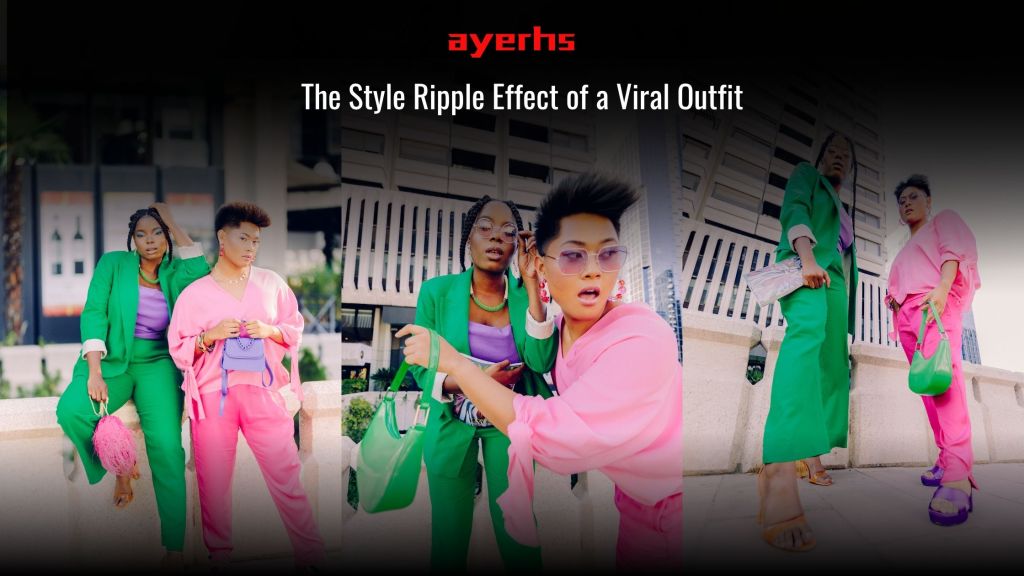
ou’re scrolling through Instagram or TikTok. Maybe it’s late at night. Maybe it’s one of those 3 p.m. coffee break scrolls. Then you see it. The outfit. The one that makes you stop. Replay. Zoom in. Save. Screenshot. Suddenly, it’s not just an outfit anymore. It’s a mood board. It’s a wishlist. It’s something you need to try. And within days, maybe even hours, it’s everywhere.
That’s the thing about fashion going viral now. It’s not just about the clothes. It’s about the moment. The mood. The energy. But most of all, it’s about the ripple effect — how a single look can move through screens and closets and reshape trends in real-time. This is the style ripple effect of a viral outfit. It starts with a post but ends up shaping what we wear, how we shop, and what we see on the streets.
So let’s talk about it. Why do some outfits go viral? What happens after they do? And how has this changed the way we experience fashion?
When the Outfit Hits Just Right
There’s no perfect formula for what makes an outfit go viral. But if you look at the ones that have, you start to notice patterns. Sometimes it’s a celebrity moment — like Zendaya in custom Mugler or Rihanna in vintage Dior. Other times, it’s a random girl in an oversized blazer and cowboy boots who somehow nails the balance between effortlessness and edge. It can even be a street style photo from Paris Fashion Week that feels just relatable enough to try yourself.
But the real spark comes when something feels fresh and achievable. Viral fashion is aspirational, but it’s also accessible. You see the look and think, I could wear that. And if not the exact pieces, then at least the vibe.
It also helps that we live in a visual-first world. Instagram grids. TikTok hauls. Pinterest boards. An outfit isn’t just worn now — it’s performed, captured, edited, and shared. A good fit can turn into content. Great content? That’s the stuff that spreads.
The Domino Effect: How It Travels
Once the outfit hits the algorithm, things move fast. A few influencers recreate the look. Fast fashion retailers notice. Dupes start showing up. Small brands tag along. Before you know it, you’re seeing variations of that same outfit in lookbooks, Instagram ads, and Zara’s new arrivals section.
And this ripple doesn’t stop at the obvious. It trickles into styling choices. Maybe it’s how the sleeves are pushed up or the socks are scrunched just right. Maybe it’s the color combination or the way the bag is slung crossbody instead of on the shoulder. These tiny details stick. They get replicated, remixed, and passed on.
It’s not always about the full outfit either. Sometimes just one item goes viral — a chunky belt, a pair of red ballet flats, a specific kind of cargo skirt — and suddenly that item becomes the anchor for a hundred other looks.
The most interesting part? This doesn’t just happen on a global scale. It happens in friend groups. In group chats. On campus. At brunch. A viral outfit might start online, but it lands in real life — and the domino effect continues.
TikTok, Instagram, and the Power of Platforms
The platforms matter. A lot.
TikTok has arguably become the biggest stage for these viral style moments. The For You Page is a breeding ground for aesthetic shifts. You see one girl in a denim midi skirt and vintage tank, then another, then five more — and suddenly “cool girl casual” is everywhere. TikTok doesn’t just show you the outfit. It shows you how it moves, how it fits, what it feels like. That creates connection. And connection drives replication.
Instagram, on the other hand, is more curated. The outfits that go viral there tend to be polished and editorial. Think mirror selfies with good lighting, vacation looks with a backdrop. But even then, the influence is strong — especially among influencers with loyal followings. If one of them wears a particular designer or pairs socks with loafers in a new way, their audience is likely to try it too.
Pinterest plays the long game. The outfit might not go viral today, but it builds slowly. A look pinned 10,000 times becomes part of the larger style mood board of the season. Pinterest also fuels the trickle-down effect — what’s trending there often re-emerges later in retail trends, styling tips, or new outfit formulas.
Each platform spreads the look differently. But together, they create a kind of collective style shift — subtle at first, but powerful.
Influencers, Celebrities, and the Everyday Style Star
Let’s not pretend that a viral outfit goes viral on its own. Someone wears it. Someone posts it. Someone — intentionally or not — becomes the face of it.
Influencers play a big role here. Especially the ones who blend aspirational style with a hint of approachability. Think Hailey Bieber off-duty looks. Or Emma Chamberlain’s quirky-cool fits. Their outfits are studied, saved, dissected — and then replicated. A matching workout set and oversized hoodie might not sound revolutionary, but when Emma wears it with chunky glasses and a top knot? Suddenly, it’s a whole vibe.
Celebrities still drive major moments, too. When Bella Hadid wore that vintage Prada mini skirt with a tank top, the whole fashion world took notes. But what’s interesting now is that non-famous people can spark the same kind of ripple. A regular girl posts an outfit breakdown. It gets picked up. Styled differently. Then seen on a bigger page. Before you know it, she’s the start of a trend wave.
That’s what makes fashion so fun now — anyone can be the source. The starting point doesn’t have to be a runway or red carpet. It can be someone walking to the coffee shop.
The Retail Chain Reaction
Once a look goes viral, the retail world responds fast.
Fast fashion brands are often the first to jump. They’ll produce dupes or inspired pieces within weeks — sometimes even days — of a trend taking off. This means you’ll find versions of the viral outfit at Zara, H&M, Mango, Shein, and beyond in no time. And whether we like it or not, these retailers are often how trends spread at scale.
But it’s not just fast fashion. Smaller brands watch these moments closely. A niche boutique might release their own take on a viral corset top or wide-leg jean. Indie labels use viral outfits as data — signals of what people are responding to emotionally, not just aesthetically.
Even thrift stores and resale apps feel the shift. Once an item gains attention, prices can spike overnight. Searches for “parachute pants” or “Miu Miu ballet flats” explode on Depop and Poshmark. Vintage stores re-merchandise based on these micro-trends. It’s like fashion stock trading — and the viral outfit is the market mover.
The Micro-Trends That Follow
Viral outfits rarely live alone. They kick off micro-trends.
Remember the “clean girl” aesthetic? That started with a few influencers in slick buns, gold hoops, white tanks, and dewy skin. It wasn’t one outfit — it was a feel. And it led to a wave of minimalistic, curated, neutral-toned looks. Suddenly everyone was wearing linen trousers and carrying mini totes.
Or think of the “blokette” trend — that sweet spot between athletic and streetwear, inspired by women styling oversized soccer jerseys with girly accessories. It started with a few fits, then took over timelines.
These moments build quickly. One viral outfit leads to a style code. That style code gets interpreted over and over until it becomes its own fashion subculture — for a month, a season, maybe even a year.
When It All Moves Too Fast
The dark side? Speed.
Trends are turning over faster than ever. An outfit can go viral in the morning and feel tired by the weekend. What’s hot today might be outdated in a few scrolls. This speed can lead to burnout — for creators, for consumers, and for the environment.
The pressure to constantly have “the next look” can feel intense. Especially for influencers and fashion lovers who want to stay current. It also feeds into overconsumption — buying more, wearing less, chasing the next viral fit.
And for brands, it’s a tricky balance. Jump too fast and you seem like you’re chasing trends. Move too slow and you miss the wave. The ripple effect is powerful — but it’s also chaotic.
The Positive Side of the Ripple
But it’s not all stressful. In fact, some of the ripple effects are refreshingly creative.
A viral outfit can inspire people to shop their closets in new ways. You see a look and realize you already own similar pieces — you just hadn’t thought to style them like that. A girl wears a sundress over wide-leg jeans and now you’re layering in ways you never considered. Inspiration spreads. Style evolves.
It also encourages experimentation. Trends feel less rigid now. There’s room to play, remix, reinterpret. The same viral look can be styled a hundred different ways — sporty, girly, minimalist, maximalist. That flexibility is exciting.
And let’s not forget community. When everyone’s loving the same look, it creates a shared fashion language. You bond with strangers over a specific belt or colorway. You tag your friend like this is so you. There’s joy in that. A little thrill in seeing fashion become a conversation.
What This Means for the Future of Style
So where does it all go from here?
The ripple effect isn’t going anywhere. If anything, it’s getting stronger. As platforms evolve and content moves faster, the influence of a single outfit will keep growing. But so will our awareness of it. People are getting savvier — they know how trends spread, and they’re starting to push back against the idea of constantly chasing.
Sustainability will (hopefully) play a bigger role. As we reckon with the impact of fast fashion, more of us are asking — how can we be part of the ripple without feeding into waste? The answer might lie in upcycling, thrifting, or learning to restyle the pieces we already own.
We might also see a return to slower trends. Style that builds over months, not days. Looks that go viral but then evolve rather than disappear. The ripple can be powerful — but it doesn’t always have to be fast.
In the End, It’s Still About Expression
At its core, a viral outfit is just that — an outfit. But it’s also a form of expression. A snapshot of how someone felt on a particular day. A mood. A moment. And when that moment resonates with others, it spreads.
That’s the beauty of fashion today. We’re all part of this giant, ever-shifting style experiment. We influence each other. We borrow. We build. One outfit inspires a thousand others — not as copies, but as echoes. That’s the ripple.
So the next time you find yourself saving a look, or putting something together that makes you feel amazing — remember, you might be the start of someone else’s fashion wave. And that? That’s pretty cool.
 Ayerhs Magazine