
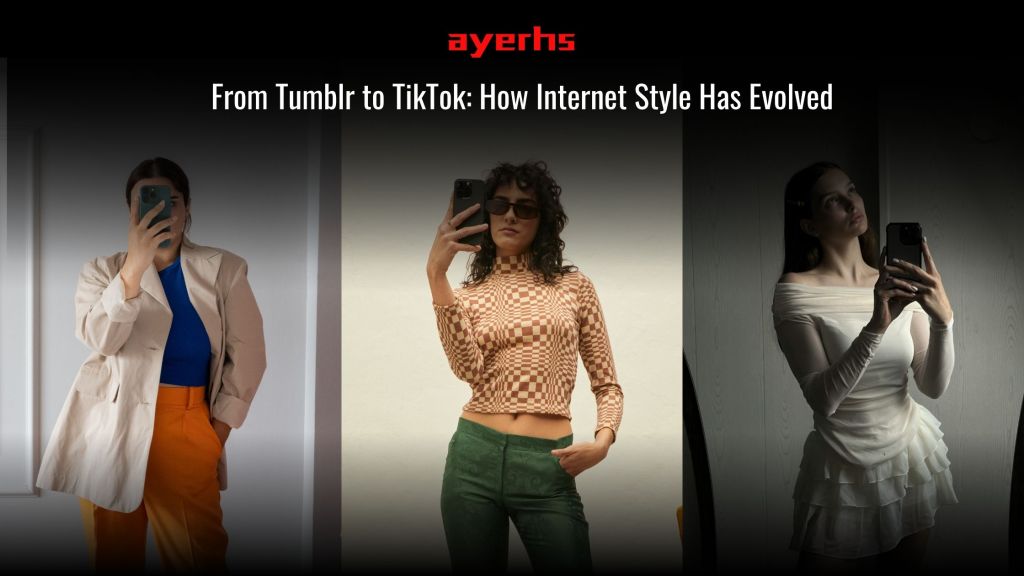
If you spent any time online in the early 2010s, you probably remember Tumblr. Not just the blogging platform itself, but the very specific aesthetic that came with it. Grunge overlays, soft filters, oversized sweaters, Doc Martens, quotes typed in lowercase Helvetica—Tumblr didn’t just influence how we posted content, it influenced how we dressed, talked, even how we saw the world.
Fast forward to now, and we’re deep in the TikTok era. Trends are moving at warp speed, aesthetics come and go in a matter of weeks, and the idea of a singular “style” has been completely turned on its head. It’s chaotic, hyper-personal, and algorithm-driven. But to understand how we got here, we have to rewind a bit.
This is the story of how internet style has evolved—shaped by platforms, users, culture, and the ever-changing ways we express ourselves online.
The Tumblr Era — Romanticizing Everything
Tumblr was more than just a microblogging site. From about 2010 to 2015, it was the internet’s moody, artsy teenager phase. The platform created a space for a new kind of identity building, one that was centered on curation. You didn’t need to post photos of yourself—your blog could be an anonymous mood board of everything you loved or wanted to be.
That’s how Tumblr style was born. It wasn’t really about brands or price tags. It was about the vibe. Black tights with holes in them. Faded band tees. Messy buns and chipped nail polish. Photos taken with old DSLRs. A Polaroid effect that made everything feel like a memory.
It was heavily influenced by indie and alternative subcultures. Think Arctic Monkeys, The 1975, Lana Del Rey, and early 2000s Kate Moss. There were a few key aesthetics that took hold—soft grunge, health goth, pastel goth, indie sleaze before it even had a name. These were less about actual fashion movements and more about internet identities.
People weren’t necessarily dressing this way offline. In fact, many didn’t have access to the kinds of clothes they blogged about. But Tumblr gave them a place to imagine it. It was a safe corner for misfits, creatives, and teens who felt misunderstood. Style wasn’t about perfection—it was about mood, angst, and expression.
Instagram’s Rise — The Era of Curation and Commercialization
Then came Instagram. It had been around since 2010, but its aesthetic dominance didn’t fully kick in until the mid-2010s. While Tumblr was dreamy and moody, Instagram was bright and aspirational. Filters still mattered, but this time they were Valencia and Clarendon, not grainy overlays. The feeds were cleaner. The selfies were glossier. Suddenly, it wasn’t just about curating mood boards—it was about curating your life.
Style shifted in response. Normcore made its entrance, with minimalism and basics taking center stage. The phrase “Instagram outfit” became a thing—carefully styled looks made to be photographed from a certain angle. Matching sets, neutral palettes, and perfect lighting replaced the rawness of Tumblr’s aesthetic.
Instagram influencers were born. And with them came affiliate links, promo codes, and brand sponsorships. Fashion became more commercial, more polished, more tied to capitalism than ever before. People weren’t just posting outfits—they were selling lifestyles.
But there was also a flip side. Streetwear exploded on Instagram, becoming mainstream in a way that was unthinkable in Tumblr’s prime. Sneakers became status symbols. Hype culture took over. Supreme, Off-White, and Yeezy became household names. Drops were documented, unboxings were filmed, and resale culture boomed.
Instagram style, especially around 2016 to 2019, was dominated by two ends of the spectrum—clean influencer chic and hypebeast maximalism. Both were driven by visibility. It wasn’t about your mood anymore. It was about your metrics.
YouTube and the Haul Culture
Somewhere in between Tumblr and TikTok, YouTube played a massive role in shaping how people thought about fashion. The platform had been around since 2005, but the late 2010s saw a huge surge in fashion and lifestyle creators.
Haul videos—where YouTubers would buy large amounts of clothes and showcase them—became hugely popular. Try-on hauls, lookbooks, styling challenges, “what I wore in a week”—these formats turned shopping into content. Fast fashion brands like Zara, Shein, PrettyLittleThing, and Fashion Nova skyrocketed in popularity thanks to YouTube’s influence.
On one hand, YouTube made style more accessible. You didn’t need to know anything about fashion history or trends. You just needed to follow the right creators. But it also fed into overconsumption. Buying more clothes became the norm. Outfit repeating was discouraged. And the more relatable a YouTuber seemed, the more likely you were to copy their entire wardrobe.
Still, YouTube brought a kind of authenticity that Instagram lacked. It gave us longer-form content, real discussions, even some educational breakdowns about personal style. It laid the groundwork for the next big shift.
The TikTok Takeover — Personal Style in a Hyper-Speed World
TikTok blew up in 2020, right when the world slowed down. And yet, the platform accelerated trend cycles to a pace we’d never seen before. Micro-trends came and went in a matter of days. The “aesthetic” culture exploded—cottagecore, dark academia, Y2K, clean girl, balletcore, coquette, tomato girl, mob wife, coconut girl, blokecore. Every week, a new vibe.
But here’s the thing—TikTok isn’t about curating perfection or polished feeds. It’s about showing up as you are, in your bedroom, dancing in front of your mirror, pulling outfits out of a thrifted pile. It brought back a sense of DIY spirit that had been lost in the Instagram age.
Suddenly, people were styling outfits from their closets instead of buying new ones. Thrifting became trendy again. “Get ready with me” videos felt intimate and low-effort. And Gen Z, who grew up with the internet, started rejecting traditional ideas of fashion altogether.
TikTok gave rise to the idea of “personal style” in a way that wasn’t tied to brand names or follower counts. It wasn’t about looking rich—it was about being creative. Maximalism came back with a vengeance. Layering, clashing prints, mixing high and low fashion, embracing “ugly” outfits—all of it became fair game.
At the same time, fashion became more political. TikTok users began calling out fast fashion, discussing the ethics of production, and promoting sustainable practices. The platform made it easier to have conversations about identity, gender expression, size inclusivity, and cultural appropriation in style. Style became a way to advocate, not just to decorate.
The Rise of Subculture Aesthetics
One of the most fascinating parts of TikTok is how it revived the idea of internet subcultures. But this time, they’re aesthetic-based rather than music- or ideology-based. Think about how “bimbo” has been rebranded as feminist. Or how goth and emo aesthetics are back, but with a soft, pastel twist. You can be fairy grunge, corporate goth, or a rainbow maximalist—it’s all valid.
Unlike Tumblr’s era of romanticized sadness, TikTok’s approach to style feels more self-aware and playful. People are trying on identities the way they try on clothes. You can be in your “clean girl” era one week and your “hot mess” era the next.
These micro-aesthetics offer a sense of belonging—but they also highlight how fashion is no longer linear. There isn’t one dominant look or trend anymore. Instead, there’s an infinite scroll of styles, each coexisting and overlapping in real time.
The Algorithm’s Influence
Of course, none of this is happening in a vacuum. The platforms themselves shape the style we see. Tumblr’s dashboard encouraged slow, moody reblogs. Instagram’s grid pushed us toward visual perfection. TikTok’s “For You” page throws us into a constant loop of what’s trending, what’s aesthetic, what’s viral.
Algorithms are now fashion gatekeepers. What ends up on your feed can dictate what you think is “in.” And with that comes a kind of digital echo chamber. If you engage with cottagecore videos, you’ll keep seeing cottagecore. If you like Y2K fashion, the app will feed you more crop tops and butterfly clips.
This has its ups and downs. On one hand, it personalizes fashion content in a way that feels tailored to you. On the other hand, it can trap people in trends they don’t even like—just because the algorithm says so.
Nostalgia and Recycling Trends
One thing all these platforms have in common? Their obsession with nostalgia. Whether it’s Tumblr’s obsession with the 90s or TikTok’s revival of the early 2000s, internet style is constantly reaching backward. That’s partly because of how cyclical fashion is—but also because the internet archives everything.
Gen Z grew up seeing their parents’ photo albums, their older siblings’ MySpace profiles, early 2000s paparazzi shots, and red carpet disasters—all on one app. They’ve seen it all, and they’re remixing it in real time.
That’s why TikTok can make a Juicy Couture tracksuit cool again. Or why Tumblr kids tried to dress like they were in a Sofia Coppola film. The internet lets us access fashion history in an instant—and reimagine it however we want.
The Future of Internet Style
So where are we going from here? If the past decade has taught us anything, it’s that internet style isn’t about one singular aesthetic anymore. It’s about fluidity. Adaptability. The ability to shift and evolve with the times—and with the platforms that host us.
We’ve gone from carefully curated mood boards to real-time outfit dumps. From blogging anonymously to showing our faces daily. From craving perfection to celebrating the messy middle.
And while TikTok currently leads the conversation, who knows what platform will be next? Maybe it’ll be even more immersive. Maybe we’ll all be styling digital outfits in the metaverse. Or maybe we’ll return to something slower, something more grounded.
Whatever comes next, one thing’s for sure—style will keep evolving, because we will keep evolving. And as long as we have the internet, we’ll have a place to express that evolution.
From Tumblr’s melancholic edits to TikTok’s chaotic fashion flips, we’ve seen it all—and somehow, we’re still just getting started.
 Ayerhs Magazine