
We do not own the rights to any of these images and they have been used in good faith. Every effort has been made to ensure that all images are used with proper credits. If you are the rightful owner of any image used on our site and wish to have it removed, please contact us at ayerhsmagazine@gmail.com and we will promptly remove it. We are a non-commercial, passion-driven, independent fashion blog and do not intend to infringe any copyright. Thank you for your understanding.
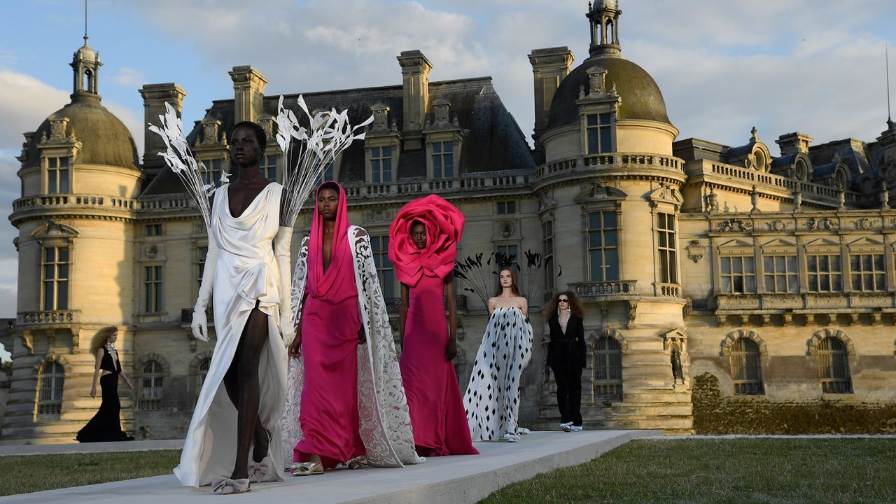
Valentino: Simplicity reigns at Château de Chantilly; the show defied expectations, questioning the symbolism of status and power within a historical site. Piccioli showcased the essence of couture through masterful simplicity, celebrating imaginative clarity. Skillfully cut and soft-draped outfits injected daywear energy. The magic of these pieces lies in their ability to turn everyday wardrobe items into something incredible. This collection has a lot of Piccioli signatures, especially those luxuriously saturated colors that we missed for the last couple of seasons. With meticulous attention to detail and an unwavering commitment to craftsmanship, Piccioli presented understated elegance and opulent extravagance. The designer’s remarkable ability to seamlessly marry these contrasting elements created simply gorgeous clothes.
Thom Browne: Thom Browne’s Couture debut was nothing short of theatrical. Seated on the stage of the historic Paris Garnier Opera house, surrounded by black and white 2,000 cardboard cutouts illustrating himself, his collection fused American sportswear with couture. It featured signature Browne silhouettes and intricate craftsmanship, incorporating themes of travel with Browne’s distinct surrealistic touch, expressed through his customary grayscale palette. Known for challenging and recreating parts of a traditional suit, all designs in the collection traced back to the timeless grey suit, serving as the foundation for every unconventional and artistic creation. This debut pushed the brand’s experimentation with accessories, themes, and captivating artistry. Browne’s mission was accomplished, showcasing his signature tailoring and conceptual brilliance in a truly remarkable way.
Dior: The collection began with a parade of (let’s be honest) quite boring all-white looks. Maria Grazia Chiuri combined simplicity in her collection, drawing inspiration from Greek and Roman antiquity. The lineup showcased sheath cape dresses, tunics, and capes made from winter fabrics made for everyday, infused with a delicate touch of shimmer. There is a sense of repetition in her work, with designs often relying on safe and predictable silhouettes. The clothes seem stagnant, failing to excite or inspire. Maria Grazia’s work evokes a sense of conformity that is far from the brand’s storied legacy.
Armani Prive: Long, elegant silhouettes, impeccable tailoring, and a touch of reserved glamour conjure visions of old Hollywood. This fall, he presents a mesmerizing display of roses in various forms—sequined, 3-D chiffon, and conceptual—each meticulously curated to enhance the individuality of his diverse clientele. Armani’s signature tailoring shines through sleek coats and pants, creating a narrow silhouette that exudes sophistication. Upon the checkerboard marble runway, the rose becomes a bodily emblem of lust and desire. Armani’s exceptional glamour shines through sumptuous eveningwear; probably my favorite collection in a while by the designer.
Chanel: Virginie Viard’s time at the helm of Chanel has been marked by a lack of clear vision. A closer examination reveals a series of missed opportunities; in this collection alone, there are numerous looks with the potential to be actually good. Viard’s collections have largely failed to create excitement throughout her entire tenure. This collection features long jackets, sequins, and tweeds complemented by comfortable yet charming silhouettes. However, this show was not just a display of clothes but a celebration of the artistry and craftsmanship that lie at the heart of French couture, and Chanel does that quite well.
Balenciaga: This collection is a bridge between past and present, honoring the art of couture while embracing innovation. The collection featured dresses entirely made of ribbons, trenches that look like they’re perpetually in motion, or denim that is actually oil-painted canvas. couture is a lot about details which Demna has been mastering quite well. His approach to creating garments that look exquisitely normal but have a rich history of technical construction has been the moat of this work. And of course, this is perfectly represented in the closing look was a 3-D printed chromed resin armor gown inspired by Joan of Arc. Craftsmanship, of course, was impeccable with sharp silhouettes – suffice to say that the clothes were brilliant.
Elie Saab: Elie Saab stays true to classic beauty, keeping his designs simple yet flattering. From luxurious fabrics to intricate details, every element of the designs pays homage to the regal elegance of medieval monarchs. The gowns are captivating in silver, black, soft gray, emerald green, amethyst, and pink. Saab is clearly a firm believer in the fantasy of traditional feminine couture, and he executes it amazingly well. After all, who doesn’t love some fantastical pretty gowns?
Rahul Mishra: Mishra’s socially conscious fashion house celebrates the collective dream of his ethical community of craftsmen, who have returned to their roots in Indian villages. This collection, ‘We, The People,’ celebrates their artistic vision and timeless craftsmanship, merging reality and imagination. Inspired by India’s rise as the world’s most populous country, we celebrate the ‘people’ who shape our identity and community. The collection dazzles with flamboyant silhouettes adorned with intricate sequined embellishments and embroidery. Mostly crafted in black and white with a pop of striking purple, the garments showcase handwork techniques like aari embroidery, thread detailing, three-dimensional appliqués, silver paillettes, and intricate flower designs, all enriching their texture.
Giambattista Valli: His collection paid homage to the purist notion of haute couture, seamlessly blending timeless aesthetics. Each garment was meticulously crafted, representing a distinct personality with weightless volumes and boundary-pushing constructions. The precise color scheme of black, white, and subtle bursts of color added clarity to the romantic theme. Valli’s runway showcased ethereal silhouettes, rich colors, and meticulous attention to detail, presenting enchanting gowns. The collection exuded a strong garden-meets-gowns vibe with floral prints, fabric rosettes, cheery prints, lace, draping, trains, fringe, and bows.
Schiaparelli: Daniel Roseberry’s latest collection breaks free from the expected, embracing spontaneity and painterly expression. He carves and drapes sculptural silhouettes, blurring and blending the boundaries of clothing, embroidery, jewelry, and textiles. Every cut and fold tells a story. The color Klein blue makes multiple appearances, elevating the thoughtfulness that Roseberry has been conveying throughout his tenure at Schiaparelli. From painted models to trompe-l’œil sculptures featuring Yves Klein blue to being engulfed in massive blanket-like proportions, a couple of carefully crafted multicolored mosaics adorn the model over the aforementioned Klein blue. Masterful construction is spotlighted in the draped cloud-like proportions and the sleek corsets. Daniel Roseberry’s surreal designs challenge the boundaries of fashion and redefine art. From heavenly craftsmanship to divine surrealism, Schiaparelli takes us beyond reality. Schiaparelli leaves no stone unturned!
Zuhair Murad: With a Vampire-esque energy, Zuhair Murad plunges into darkness with this collection. Murad’s darkly enchanting collection features lace corsets, cage skirts, feathers, raven motifs, and embellished spider webs. The macabre rose embedded in flowy gowns symbolizes romance, while sensual black lace exudes high-end seductiveness. Its delicate lace patterns and sheer transparency leave a trail of mystery. With each piece, he masterfully combines elements of gothic allure, sensuality, and timeless elegance, creating unforgettable looks.
Alexandre Vauthier: Vauthier’s mastery of cut and construction shines through in inventive draping and asymmetries, while the colors highlight individualism on a neutral, elegant canvas. Vauthier expertly plays with fabrics, creating flowing dresses that hug the figures in all the right places, evoking a sense of subtle sensuality. From showstopping capes to precise tailoring, this collection blends drama with unwavering confidence. Each piece has been meticulously crafted with precise tailoring, showcasing Vauthier’s mastery of the couture craft.
Jean Paul Gaultier: With Julien Dossena as the latest collaborator at JPG Couture, expectations were sky-high, and he did not disappoint. Honoring the late Paco Rabanne, Dossena effortlessly blends the essence of two fashion icons. From modernized chainmail to bohemian glamour, his designs redefine elegance, blending contrasting elements to achieve a harmonious balance between modernity and tradition, as well as masculine and feminine aesthetics. Inspired by Gaultier’s iconic archival pieces, Dossena brilliantly reimagines and reinvents these fashion milestones. In an inclusive move, Dossena crowns his street-inspired ‘characters’ with crowns, symbolizing unity in the vibrant diversity of Paris. Skillfully blending past and present while avoiding clichés, imagine opulent military-style blazers, audacious cone-bra dresses, faux fur trapper hats, dragon-embroidered corsets, pinstripe corset suits, and mesmerizing liquid-mesh chainmail gowns gracing the runway. It’s a stunning collision of Dossena’s vision and Gaultier’s legacy.
Threeasfour: Can you distinguish between computer-generated and real garments? If not, that’s the point. This collection takes us on a journey through a parallel universe, blurring the lines between reality and imagination. Each design showcased in the lookbook possesses either a digital replica or a physical counterpart. With digital and physical pieces that mirror each other, the confusion is part of the fun. Led by Gabriel Asfour, Angela Donhauser, and Adi Gil, the collection pushes the boundaries of fashion innovation. Blending digital advancements with Haute Couture craftsmanship, their ethereal creations are both surreal and surprisingly natural. Working together with Placebo, the collection explores the juxtaposition of different worlds and the concept of what is real. The collection showcases topographic patterns, repurposed materials, and nods to fashion history, giving off a very ’60s futuristic energy.
Viktor & Rolf:
I do believe that it is next to impossible to dislike a collection by Viktor & Rolf. For this collection, the spotlight was on swimsuits. Even though there have been many couture swimsuits across the decades, I have never thought of swimsuits in a good Couture-esque way. The designer duo takes on the humble garment and transforms it into countless humorous interpretations. There are references to their own iconic ideas: heavy ruffles, 3D cubic catchphrases, massive bows, and headless mannequins hanging off the models. The designers have never been shy of experimentation, and this blend of an everyday clothing item into their landmark creative motifs is somehow very typical of them, but of course, it is unexpected. This juxtaposition and surreal surprise element that they always feature in their collections is what makes couture COUTURE. They have been able to truly capture the essence of what Couture can represent. The intention and purpose of Haute Couture need to shift as we move forward in time. Their truly artistic approach is refreshing. Titled ‘Embodiment,’ this lineup truly reflects their artistic brilliance and conceptual approach to fashion over the decades.
Fendi: Drawing inspiration from Delfina’s breathtaking Fendi high jewelry collection, the exhibition seamlessly blends an array of earthy tones, luxurious draping, and intricate needlework. Jones envisions a refined line of luxurious eveningwear, skillfully merging minimalist design principles with subtle nods to the timeless statuary of ancient Rome. With volume, fluidity, and comfort, they empower women through versatile garments. Guided by jeweled embellishments, intricate embroideries, delicious satin, bandage-style draping, and sleek silhouettes, this collection is by far the Kim Jones for Fendi. The looks embrace simplicity and timeless designs that cater to the everyday woman, the everyday Couture woman, of course. Fendi embraces femininity with noticeable ease and flexibility.
Iris Van Herpen: In a small garden in Paris, the Dutch couturier showcased a breathtaking interchange between aquatic architecture and bionic innovations, pushing the boundaries of experimentation and exploration. Van Herpen drew inspiration from projects like Oceanix and visionary architect Jacques Rougerie, translating their fluid structures into sartorial marvels. Titled ‘Architectonic,’ the collection blurred the line between wearable and functional designs, seamlessly acclimating to the environment. With laser-cut geometries, embroidered mandala-like patterns, and iridescent seashell motifs, Van Herpen’s creations evoked the wonders of the deep sea. While this wasn’t her best collection, everyone is allowed one average collection.
Pictures courtesy of Vogue Runway
Featured Image
We do not own the rights to any of these images and they have been used in good faith. Every effort has been made to ensure that all images are used with proper credits. If you are the rightful owner of any image used on our site and wish to have it removed, please contact us at ayerhsmagazine@gmail.com and we will promptly remove it. We are a non-commercial, passion-driven, independent fashion blog and do not intend to infringe any copyright. Thank you for your understanding.
 Ayerhs Magazine